
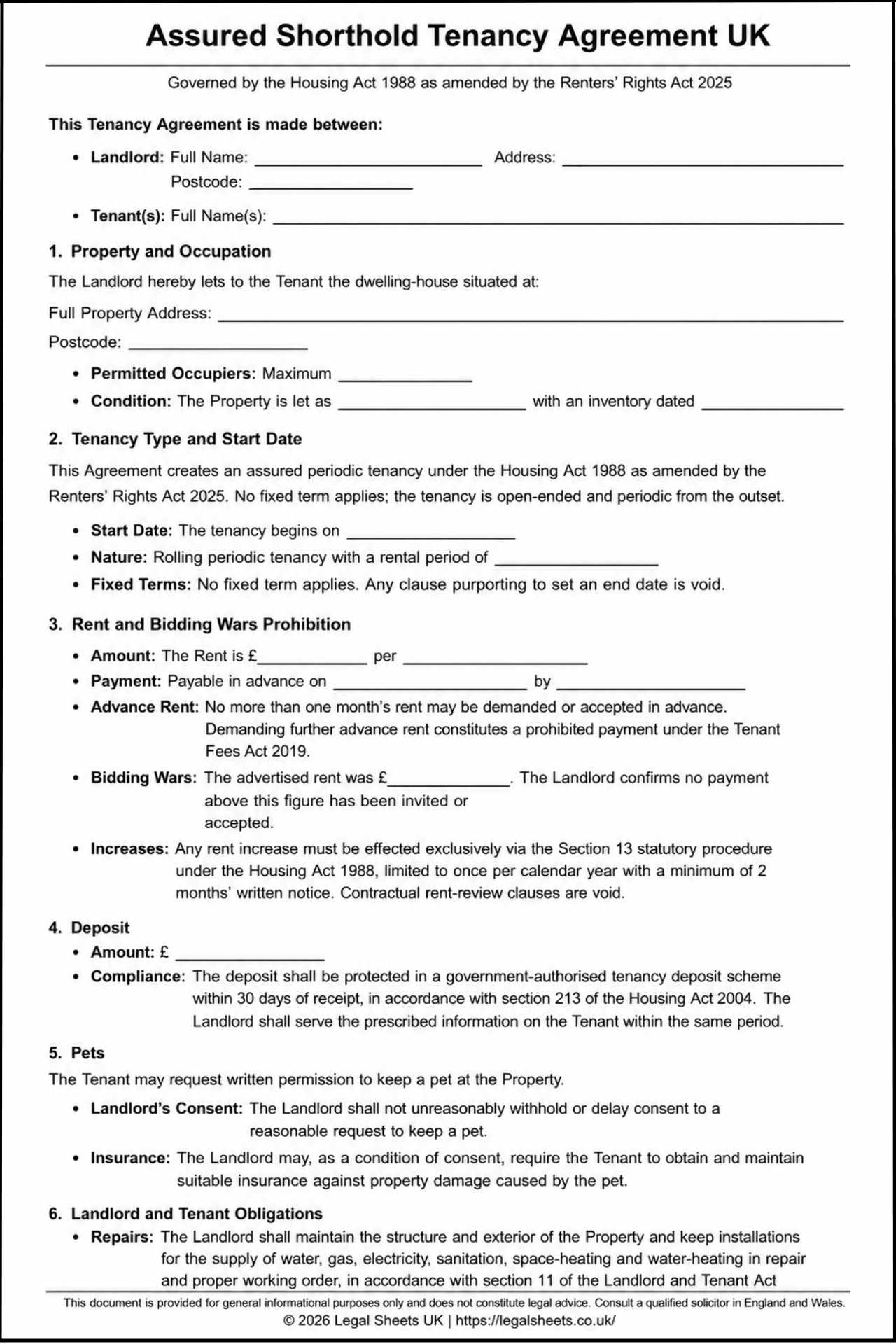
Assured Shorthold Tenancy Agreement [Free Fillable, Printable PDF]
A surprising number of disputes start not with unpaid rent or property damage, but with an Assured Shorthold Tenancy Agreement that was copied from an old template and never updated for current England tenancy requirements. By the time a landlord needs to rely on the agreement, County Court possession proceedings can expose gaps in the paperwork, particularly where deposit protection obligations or prescribed information were not dealt with properly at the beginning of the tenancy.
The legal framework still stems from the Housing Act 1988, yet many practical problems arise from what happened before the tenant even moved in rather than from later conduct during the tenancy. Whether you’re granting a new tenancy, replacing an existing agreement, or checking terms before signing, having accurate wording from the outset often proves far more valuable than trying to correct mistakes after a dispute has developed. The template and guidance that follow are designed for residential lettings in England and reflect the practical issues that commonly arise when an Assured Shorthold Tenancy is later examined or enforced.
Table of Contents
ToggleAssured Shorthold Tenancy Agreement UK Template (PDF, Word & Printable Formats)
Before Using an AST Agreement, Confirm the Tenancy Qualifies
Occupation Arrangements That Commonly Fall Within the AST Regime
ASTs are most commonly used where the property is occupied as a private residence by:
- A sole tenant
- Joint tenants
- A family household
- Standard residential occupiers
Situations Frequently Mistaken for ASTs
Problems often arise where parties incorrectly assume an arrangement is an AST when it may actually involve:
- Lodger arrangements
- Licence agreements
- Holiday lets
- Company lets
- Resident landlord occupation
Why Classification Matters
Classification affects:
- Possession procedures
- Deposit obligations
- Notice requirements
- Enforcement routes
A landlord relying on the wrong document may discover the issue only after commencing possession proceedings.
The Clauses That Usually Determine Whether the Tenancy Runs Smoothly
Rent Collection and Payment Terms
Disputes concerning rent arrears frequently begin with vague payment clauses.
An effective AST identifies payment dates, accepted payment methods, consequences of late payment, and any interest provisions. Where rent records become inconsistent, proving arrears later can become significantly more difficult.
Deposit Clauses and Financial Protection Provisions
The deposit clause should clearly explain:
- Deposit amount
- Permitted deductions
- Return procedures
- Deposit protection arrangements
Many County Court disputes arise because deductions were discussed verbally but never properly documented.
Occupancy Limits and Additional Occupiers
Occupation clauses should distinguish between:
- Authorised occupiers
- Long-term residents
- Guests
- Unauthorised subletting
Unrecorded occupiers can create complications where licensing requirements apply.
Property Use Restrictions
Most ASTs restrict use to residential occupation only.
Additional provisions may address:
- Business activities
- Pets
- Smoking
- Property alterations
Restrictions should be practical and enforceable rather than overly broad.
Access and Inspection Rights
One of the most common drafting mistakes is the inclusion of unrestricted access provisions.
Under the Protection from Eviction Act 1977 and the Consumer Rights Act 2015, clauses allowing entry without proper notice are unlikely to be enforceable. In practice, landlords generally provide at least 24 hours’ written notice except during genuine emergencies.
Repair Responsibilities Without Breaching Statutory Rights
Many outdated AST templates still contain clauses attempting to shift major repair liabilities to tenants.
Under Section 11 of the Landlord and Tenant Act 1985, landlords remain responsible for the structure, exterior, and key service installations. Clauses attempting to transfer these obligations are generally void and often become a focal point in disrepair disputes.
The Compliance Documents That Protect Future Possession Rights
Providing the How to Rent Guide
Before or at the start of the tenancy, tenants should receive the current government-issued How to Rent guide.
Failure to provide the guide can undermine a later Section 21 possession route.
Serving a Valid Energy Performance Certificate
A valid EPC must be provided to the tenant free of charge.
Failure to comply may invalidate future Section 21 proceedings and expose landlords to financial penalties.
Gas Safety Certificate Requirements Before Occupation
Where gas installations exist, the Gas Safety Certificate should be provided before occupation begins and renewed annually.
Possession claims regularly encounter difficulties where landlords cannot prove service of the original certificate.
Right to Rent Verification Process
Before the tenancy starts, landlords must verify the immigration status of adult occupiers in accordance with the Immigration Act 2014.
Failures can result in significant civil penalties and, in serious cases, criminal consequences.
Why Missing Documents Can Block a Future Section 21 Notice
Many landlords only discover compliance problems when preparing possession proceedings.
The Accelerated Possession Procedure relies heavily on documentary evidence. Missing certificates, missing guides, or incomplete service records frequently result in claims being rejected or delayed.
Deposit Handling Mistakes That Frequently Lead to Claims
The 30-Day Registration Deadline
Under Section 213 of the Housing Act 2004, deposits must be protected within 30 days of receipt.
The deadline is strict. Late compliance often creates long-term possession difficulties.
Prescribed Information Requirements
Protection alone is insufficient.
Prescribed information relating to the selected scheme must also be served within the same 30-day period together with the relevant scheme information.
Government-Approved Deposit Schemes
Approved schemes include:
- DPS
- TDS
- MyDeposits
Each scheme has its own administrative procedures, but statutory deadlines remain the same.
Financial Consequences of Non-Compliance
Potential consequences include:
- Deposit penalty claims
- Possession barriers
- County Court proceedings
- Tenant counterclaims
Courts may order landlords to pay between one and three times the deposit amount where statutory requirements have not been met.
Deposit Errors That Commonly Surface During Possession Proceedings
Many landlords assume deposit compliance will never be scrutinised.
In reality, tenants frequently raise deposit failures as a defence or counterclaim when facing possession proceedings.
Tenant Fees Rules and Clauses That Should Never Appear in an AST
Charges That Are Generally Prohibited
The Tenant Fees Act 2019 prohibits most charges previously found in older tenancy agreements, including:
- Referencing fees
- Credit check fees
- General administration charges
- Inventory check-out fees
For further information see the Tenant Fees Act 2019.
Security Deposit Caps
Security deposits are generally capped at:
- Five weeks’ rent where annual rent is below £50,000
- Six weeks’ rent where annual rent is £50,000 or more
Holding Deposit Limits
Holding deposits are generally limited to one week’s rent.
Why Unlawful Fees Can Prevent Possession Proceedings
An unlawful fee can create wider consequences than many landlords expect.
A landlord who has collected a prohibited payment may be unable to rely on a Section 21 notice until the prohibited sum is refunded.
Common Legacy Clauses Still Found in Outdated AST Templates
Common examples include clauses requiring tenants to pay:
- Referencing charges
- Administrative fees
- Renewal fees
- Check-out fees
These provisions frequently survive in older templates despite being unenforceable.
Signing, Execution and Record-Keeping Decisions for Assured Shorthold Tenancy Agreement
When an AST Can Be Created Without a Deed
Pursuant to sections 52 and 54(2) of the Law of Property Act 1925, an AST for three years or less may generally be created orally or in writing without deed execution.
Circumstances Requiring Deed Execution
Tenancies exceeding three years generally require execution as a deed.
Failure to observe the correct formalities can create uncertainty regarding enforceability.
Electronic Signatures and Practical Evidence
Regardless of signature method, landlords should retain evidence showing when and how the agreement was executed.
Documents Landlords Should Retain After Signing
Good record management normally includes retaining:
- Signed agreement
- Deposit protection evidence
- Service records
- Compliance certificates
- Inventory documentation
Poor record retention frequently becomes a greater problem than poor drafting.
Managing the Tenancy After the Agreement Is Signed
Rent Reviews and Mid-Tenancy Changes
Changes to rent should be documented carefully.
Disputes often arise where informal arrangements are agreed verbally and later disputed.
Tenant Requests and Property Alterations
Requests concerning alterations, additional occupiers, or pets should be recorded consistently.
Renewals Versus Statutory Periodic Tenancies
The Transition to Universal Periodic Tenancies Fixed-term tenancies are obsolete. On 1 May 2026, all existing ASTs automatically converted into rolling, monthly Assured Periodic Tenancies by operation of law. Landlords are prohibited from issuing renewals or entering into new fixed-term commitments; tenants may terminate the agreement at any stage by providing a minimum of two months’ notice. Furthermore, landlords face a strict statutory duty to have provided all active tenants with ‘The Renters’ Rights Act Information Sheet 2026′ by 31 May 2026 to avoid civil penalties.
Handling Occupancy Changes
Changes in occupiers can affect licensing obligations and risk assessments.
Record-Keeping That Becomes Critical During Disputes
Possession claims frequently depend upon:
- Service records
- Rent schedules
- Deposit documentation
- Compliance evidence
Judges often focus more on documentary evidence than recollections.
Where AST Agreements Commonly Fail During Possession Claims
Missing Deposit Documentation
Missing protection records frequently derail otherwise straightforward possession claims.
Incorrect Service of Prescribed Information
Late or defective service remains one of the most common compliance failures.
Failure to Serve Compliance Documents
The absence of EPC, Gas Safety, or How to Rent evidence regularly becomes a decisive issue.
Defective Notice Clauses
Poorly drafted service provisions can create disputes about whether notices were validly served.
Poor Evidence of Service
A document may have been provided, but proving service is often the real challenge.
Inconsistent Tenancy Records
Conflicting tenancy dates, rent figures, or occupier information can undermine credibility before the court.
Possession Routes Under an Assured Shorthold Tenancy Agreement
Using Section 21 Following Full Compliance
Section 21 requires strict procedural compliance.
Under the Housing Act 1988 and Deregulation Act 2015, a Section 21 notice generally requires at least two months’ notice and cannot be served during the first four months of the original tenancy.
For legislative details see the Housing Act 1988.
Using Section 8 for Rent Arrears or Breaches
Section 8 possession claims rely on statutory grounds.
Notice periods vary depending upon the ground being relied upon, including shorter periods for serious rent arrears.
Why the AST Itself Becomes Key Court Evidence
The agreement often forms the foundation of the entire possession case.
Errors in tenancy dates, rent clauses, or occupier details can create avoidable litigation issues.
Accelerated Possession Procedure Realities
The accelerated route is largely paper-based.
Where supporting documents are missing, judges frequently dismiss or delay applications without reaching the possession stage.
Common Reasons Judges Reject Possession Applications
Common issues include:
- Deposit failures
- Missing prescribed information
- Missing compliance documents
- Poor service evidence
- Inconsistent paperwork
Licensing and Property-Specific Issues Often Missed at Drafting Stage
HMO Licensing Considerations
Where HMO licensing applies, landlords must obtain the appropriate licence from the local authority.
Selective Licensing Schemes
Some local authorities impose selective licensing requirements beyond traditional HMO arrangements.
Additional Occupier Risks
Occupier numbers can affect both licensing obligations and enforcement exposure.
Rent Repayment Order Exposure
Tenants increasingly pursue Rent Repayment Orders through the First-tier Tribunal where licensing requirements have not been met.
Awards can require repayment of up to 12 months’ rent in qualifying circumstances.
Assured Shorthold Tenancy Agreement and Related Documents
AST Agreement vs Licence to Occupy
A licence generally grants permission to occupy without creating the same tenancy structure commonly associated with an AST.
AST Agreement vs Assured Tenancy Agreement
Although often confused, an assured tenancy agreement and an assured shorthold tenancy agreement do not provide identical possession frameworks.
AST Agreement vs Lodger Agreement
A lodger arrangement typically involves a resident landlord and different occupation rights.
AST Agreement vs Section 21 Notice
The AST creates the tenancy relationship. A Section 21 notice is a possession document used later in the tenancy lifecycle.
AST Agreement vs Section 8 Notice
A Section 8 notice relies upon specific statutory grounds, while the AST records the contractual arrangement.
AST Agreement vs Guarantor Agreement
A guarantor agreement creates separate obligations for a third party who agrees to support the tenant’s liabilities.
UK Legal Facts and Compliance Framework
Legal Requirements
| Topic / Issue | England Legal Rule | Governing Law |
|---|---|---|
| Execution Formalities | ASTs of 3 years or less may be oral or written; longer terms generally require a deed | Law of Property Act 1925 (ss.52, 54(2)) |
| Deposit Protection | Deposit and prescribed information must be completed within 30 days | Housing Act 2004 (s.213) |
| Tenant Fees & Deposit Caps | Most fees prohibited; deposit and holding deposit caps apply | Tenant Fees Act 2019 |
| Repairing Obligations | Landlord responsible for structure, exterior and specified installations | Landlord and Tenant Act 1985 (s.11) |
| Section 21 Notice Rules | Minimum notice and timing restrictions apply | Housing Act 1988 (s.21); Deregulation Act 2015 |
| Section 8 Notice Rules | Notice periods depend on statutory grounds | Housing Act 1988 (s.8) |
| How to Rent Guide | Must be provided to preserve Section 21 rights | Deregulation Act 2015 |
| EPC Requirements | Valid EPC must be supplied to tenant | Energy Efficiency (Private Rented Property) (England and Wales) Regulations 2015 |
| Gas Safety Requirements | Certificate required before occupation where gas exists | Gas Safety (Installation and Use) Regulations 1998 |
| Right to Rent Checks | Checks required before tenancy begins | Immigration Act 2014 |
Practical Legal Impact
For landlords, compliance failures rarely appear serious when the tenancy begins. Problems typically emerge much later when possession is required, a deposit claim is issued, or a local authority investigates licensing obligations.
County Court judges routinely examine documentary compliance before considering possession. Likewise, the First-tier Tribunal regularly deals with disputes involving licensing failures, rent repayment claims, and tenant fee issues. A modern AST should therefore be treated as part of a wider compliance record rather than an isolated contract.
Frequently Asked Questions
Can a landlord use a Section 21 notice if the deposit was protected late?
Late protection can create significant obstacles. Under the Housing Act 2004, deposit protection and prescribed information obligations must be completed within 30 days. Landlords frequently encounter possession difficulties where those deadlines were missed.
Further guidance is available through official Deposit protection rules.
What happens if the tenant never received the How to Rent guide at the start of the tenancy?
Failure to provide the required guide can invalidate a later Section 21 notice. The issue often arises during possession proceedings when landlords cannot prove service.
Can an AST clause require the tenant to pay for boiler repairs or structural defects?
No. Section 11 of the Landlord and Tenant Act 1985 prevents landlords from contracting out of statutory repairing obligations relating to the structure, exterior, and specified installations.
Will a possession claim fail if the landlord cannot prove service of the EPC or Gas Safety Certificate?
Evidence of service is frequently scrutinised during possession proceedings. Missing evidence can create serious procedural difficulties and may undermine reliance on a Section 21 notice.
What evidence should a landlord keep to defend against deposit penalty claims or possession challenges?
Landlords should retain:
- Signed AST documentation
- Deposit protection confirmation
- Prescribed information records
- EPC evidence
- Gas Safety records
- How to Rent service evidence
- Rent payment records
- Inventory documentation
In many County Court possession cases, the outcome turns less on the wording of the AST agreement and more on whether the landlord can prove compliance with the associated statutory requirements.
Author
-

Ankur is the founder and editorial reviewer at LegalSheets. He researches, writes, and reviews legal content, ensuring every template and guide is clear, accurate, and based on current UK laws and official government guidance. His focus is on making legal documents easier for individuals and businesses to understand and use.
