
SaaS Agreement Template (Free PDF & Word)
Businesses usually start looking for a Saas Agreement when a software subscription is ready to go live, only to realise that data handling, renewal rights and service commitments haven’t been recorded with enough precision. In England, that oversight becomes far more significant where the provider processes customer data, because Article 28 of the UK GDPR and the Data Protection Act 2018 require appropriate contractual provisions rather than informal commercial understandings.
It’s not unusual for disagreements to surface when a customer wants its data returned after termination, with the Information Commissioner’s Office examining data protection obligations and any contractual dispute potentially ending up before the County Court. The wording you choose at the outset can make those discussions far more straightforward, so the template and completion notes that follow are designed for the practical realities of supplying software as a service.
Table of Contents
ToggleSaaS Agreement Template (PDF, Word & Printable Formats)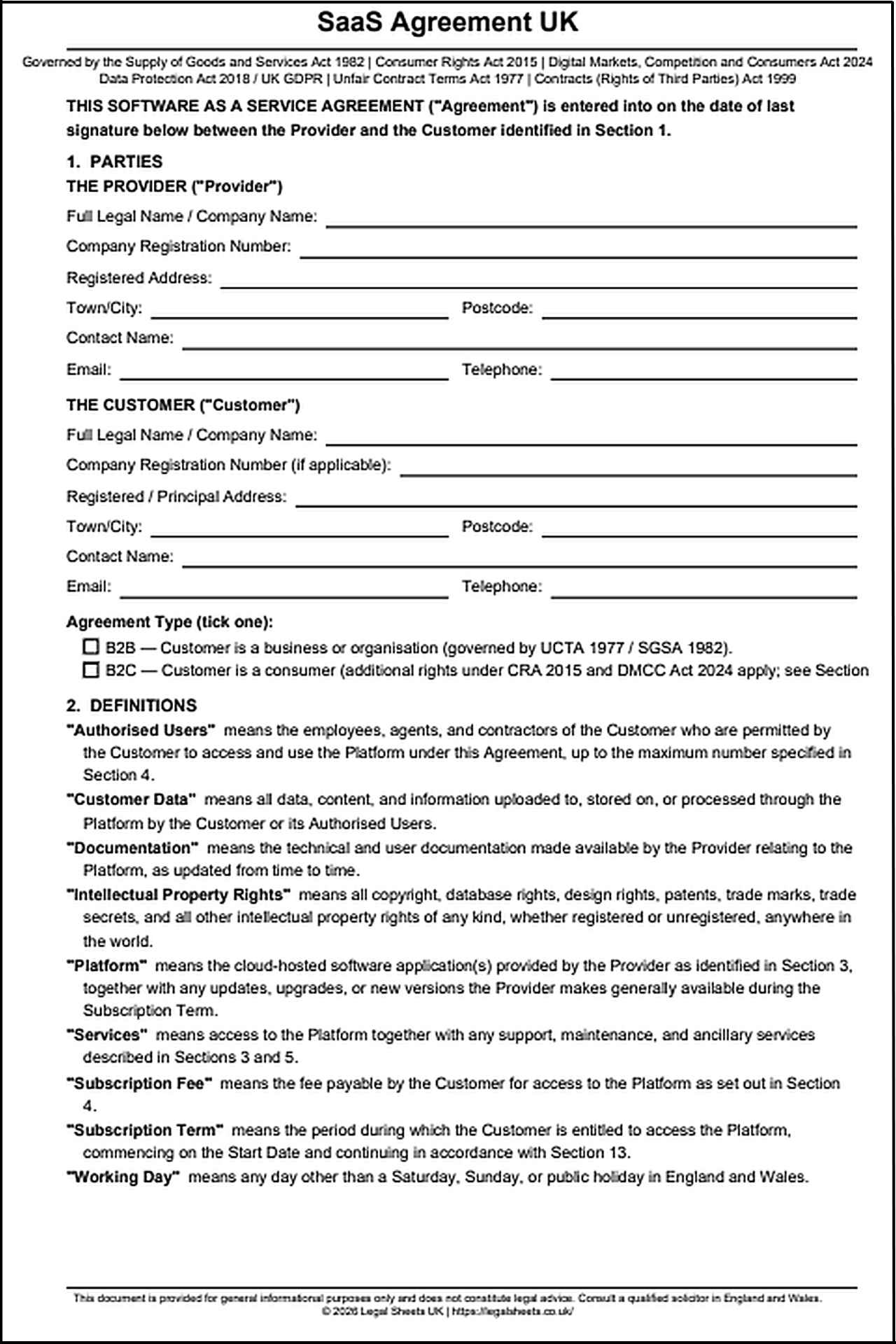
Situations Where a SaaS Agreement Becomes Necessary
A SaaS Agreement is usually prepared before customers are given access to an online platform, but many businesses only appreciate its value after the first commercial disagreement. Subscription software creates continuing obligations rather than a one-off sale, so expectations around payments, support, system availability and customer data should be recorded from the outset.
Launching a software subscription service
Launching a subscription platform creates an ongoing commercial relationship between the provider and its customers. Users expect continued access to the software together with updates, maintenance and technical assistance throughout the subscription period.
The agreement should clearly explain:
- When subscriptions begin
- Billing frequency
- Renewal arrangements
- Payment methods
- Circumstances allowing suspension
- How either party may terminate the subscription
Without clear wording, disagreements frequently arise over renewal dates, cancelled subscriptions and continued platform access.
Licensing cloud software to business customers
Business customers often rely on cloud software for essential operations. They usually expect certainty about authorised users, permitted business activities, account restrictions, software updates and available support.
Recording these matters within the agreement prevents misunderstandings about how the software may be used. As organisations become increasingly dependent upon cloud services, uncertainty over access rights or support obligations can quickly become an expensive contractual dispute.
Managing customer data through the platform
Customer data is often one of the most valuable assets handled by a SaaS provider. Where the provider stores or processes personal information on behalf of a customer, Article 28(3) of the UK GDPR requires a written contract containing prescribed processor obligations.
These obligations include acting only on documented instructions, maintaining confidentiality, implementing appropriate technical and organisational security measures, assisting with data subject requests, allowing audits where appropriate and returning or deleting personal data when the agreement comes to an end.
Institutional customers commonly review these provisions during supplier due diligence. Missing Article 28 wording is a frequent reason why commercial contracts require further negotiation before they can be approved.
Agreeing support, uptime and subscription terms
Many disputes concern the services surrounding the software rather than the software itself. Customers often expect continuous availability, prompt technical support and regular updates, while providers may intend to deliver a more limited level of service.
The agreement should clearly state planned maintenance windows, expected service availability, support channels, response times and update procedures. Subscription fees, renewal dates and payment obligations should also be expressed in precise commercial language so that there is little uncertainty if disagreements arise later.
Key Clauses Every SaaS Agreement Should Include
A software as a service agreement is designed to allocate responsibilities throughout the subscription period. Each clause should deal with an operational issue that commonly causes commercial disputes if left unclear.
Software access and permitted use
Rather than selling software outright, the provider grants the customer permission to access the hosted platform under agreed conditions.
The agreement should specify:
- Who may use the software
- User limits
- Permitted business purposes
- Prohibited activities
- Account security responsibilities
- Restrictions on copying, reverse engineering or redistribution
Clear licence provisions reduce disputes over unauthorised access and improper use of the platform.
Subscription fees and payment terms
Subscription charges should be described with enough detail that neither party is left uncertain about their financial obligations.
The agreement should cover:
- Pricing structure
- Billing intervals
- Payment methods
- VAT where applicable
- Renewal arrangements
- Late payment provisions
- Circumstances allowing price increases
If your agreement lacks a robust contractual remedy for arrears, the Late Payment of Commercial Debts (Interest) Act 1998 automatically imposes statutory interest at 8% above the Bank of England base rate, alongside fixed debt recovery compensationWell-drafted payment provisions also make debt recovery more straightforward if a customer stops paying.
Service availability and support
Customers rarely expect a cloud platform to operate without interruption, but they do expect transparency about the service they are purchasing.
The agreement should explain:
- Expected uptime
- Planned maintenance
- Emergency maintenance
- Technical support channels
- Response times
- Software updates
- Service credits where applicable
Service credits should be drafted carefully. Service credits must be proportionate. If English courts classify them as excessively punitive rather than a legitimate mechanism to protect commercial interests (applying the Makdessi test), they will be struck out entirely as void penalty clauses. A balanced approach is therefore more likely to reflect the commercial intentions of both parties.
Key Clauses Every SaaS Agreement Should Include
Customer responsibilities
A SaaS provider cannot deliver its service effectively unless customers also meet certain obligations. The agreement should make it clear that customers are responsible for protecting login credentials, using the software lawfully, supplying accurate account information and maintaining compatible hardware or internet connections where necessary.
It is also sensible to explain that customers remain responsible for the content they upload to the platform. If this is left unclear, disputes may arise where unlawful, infringing or inappropriate material is stored within the software.
Intellectual property ownership
One of the most valuable parts of any SaaS business is its intellectual property. Customers are purchasing access to the software rather than ownership of the underlying source code, branding or technology.
The agreement should clearly distinguish between:
- The provider’s ownership of the software
- The customer’s ownership of its own data
- Any customer-generated content
- Third-party software integrated into the platform
Clear ownership provisions become particularly important if the commercial relationship ends or a customer moves to another software provider.
Data processing and UK GDPR obligations
Where the provider processes personal data on behalf of the customer, the agreement must include the processor obligations required by Article 28(3) UK GDPR.
These provisions normally require the provider to:
- Process data only on documented instructions
- Maintain staff confidentiality
- Implement appropriate technical and organisational security measures
- Assist with data subject requests where appropriate
- Return or delete personal data at the end of the agreement
- Permit audits where required
Using imported boilerplate contracts that omit these Article 28 mandates renders the data processing fundamentally illegal. In the current June 2026 regulatory climate, this exposes both parties to immediate ICO investigations and maximum statutory fines of up to £17.5 million or 4% of global turnover.
Confidentiality
Customers often provide commercially sensitive information while using cloud software. The agreement should define what information remains confidential, how it may be used and the circumstances in which disclosure is permitted.
Confidentiality obligations commonly continue after the agreement has ended, particularly where proprietary business information or trade secrets have been shared.
Limitation of liability
Liability provisions are among the most heavily negotiated parts of a SaaS Agreement.
Under the Unfair Contract Terms Act 1977, a provider cannot exclude or restrict liability for death or personal injury resulting from negligence. Under Sections 3 and 11 of the Unfair Contract Terms Act 1977 (UCTA), any liability cap or exclusion for a breach of contract in a standard-terms B2B agreement must pass a strict ‘reasonableness’ test. If it fails, the judge will strike the clause completely, leaving the provider’s liability uncapped.
A clause attempting to exclude all liability for data loss, security failures or prolonged service outages may not withstand scrutiny if challenged. Courts assess these clauses by considering factors such as bargaining strength, insurance availability and the commercial context of the agreement.
Suspension and termination
Circumstances sometimes arise where access to the platform must be suspended or the agreement brought to an end.
The agreement should explain:
- Events allowing suspension
- Grounds for termination
- Required notice periods
- Immediate termination rights
- Outstanding payment obligations
- Customer responsibilities following termination
Clear termination provisions reduce uncertainty when the commercial relationship can no longer continue.
Data return or deletion after termination
One of the most common disputes following termination concerns customer data.
The agreement should explain:
- How customers may obtain their data
- Available export formats
- Time limits for requesting exported data
- When data will be permanently deleted
- Whether backup copies will be retained
Providers that permanently lock or destroy a client’s proprietary data during a dispute risk severe judicial pushback. English courts routinely grant urgent High Court injunctions compelling data extraction, often penalising the SaaS provider with heavy adverse costs for wrongful interference
UK Legal Requirements for SaaS Agreements
Legal Requirements Table
| Topic / Issue | Precise Legal Rule | Governing Statute / Regulation |
| Electronic Execution | Click-wrap, shrink-wrap, and digital signatures are legally sufficient to form a binding commercial SaaS contract. | Common Law & Electronic Communications Act 2000 |
| B2B Data Processing | If the platform hosts personal data, the contract must contain mandatory clauses governing security, audits, and data deletion. | UK GDPR, Article 28(3) & Data Protection Act 2018 |
| B2C Digital Content | Consumer-facing SaaS platforms must deliver digital content that is of satisfactory quality, fit for purpose, and exactly as described. | Consumer Rights Act 2015, ss. 34–36 |
| Implied B2B Standards | The provider must perform cloud hosting and technical support services with reasonable care and skill. | Supply of Goods and Services Act 1982, s.13 |
| Voiding Unfair Terms | Contractual clauses excluding liability for breach of contract on standard terms must be commercially reasonable or face being struck out. | Unfair Contract Terms Act 1977, s.3 & s.11 |
| Negligence Exclusions | A SaaS provider is strictly prohibited from excluding or capping liability for death or personal injury caused by their negligence. | Unfair Contract Terms Act 1977, s.2(1) |
| Statutory Default Interest | Without a substantial alternative remedy, overdue B2B SaaS invoices automatically accrue interest at 8% over the BoE base rate. | Late Payment of Commercial Debts (Interest) Act 1998 |
| Service Credits / Penalties | Contractual refunds for server downtime (SLAs) must not be disproportionately punitive, or they violate the rule against penalties. | Common Law (Makdessi doctrine) |
Practical Legal Impact
Although a SaaS Agreement remains a private commercial contract and does not require registration with Companies House or any government authority, its drafting can have significant legal consequences. Businesses that process personal data should include the mandatory processor clauses required by Article 28 UK GDPR, as their omission may expose both parties to regulatory investigation by the Information Commissioner’s Office (ICO).
Liability clauses should also be drafted with care. A liability cap that is commercially unreasonable may be struck down by the courts, potentially leaving the provider exposed to substantially greater financial claims than expected.
Where subscription fees remain unpaid, providers commonly pursue recovery through the County Court. More complex disputes involving cloud infrastructure, software failures or significant commercial losses may instead be heard within the Technology and Construction Court, where technical evidence frequently plays a central role.
Common Drafting Mistakes That Cause Problems
Missing Article 28 data processing clauses
Many providers begin with overseas contract templates that do not reflect UK GDPR requirements. Missing processor clauses often delay commercial negotiations and may prevent institutional customers from approving the agreement.
Unreasonable liability exclusions
Attempting to exclude every possible form of liability rarely produces the desired protection. If the limitation clause fails the statutory reasonableness test, the court may disregard it entirely.
Unclear service level commitments
Promising continuous availability without defining maintenance periods, response times or service levels creates unrealistic expectations. Clear wording reduces disagreement when planned maintenance or temporary outages occur.
No clear process for customer data retrieval
Customers often need access to their business records immediately after termination. Agreements that fail to explain how data can be exported frequently become the source of urgent commercial disputes.
Vague termination and renewal wording
Automatic renewals, notice periods and cancellation procedures should be described in straightforward language. Ambiguous wording regularly causes disagreement over continuing subscription fees.
What Happens If a SaaS Agreement Is Breached
A breach does not always involve complete failure of the software. More commonly, disputes concern unpaid subscription fees, prolonged downtime, missed service commitments or disagreements about customer data.
Where customers fail to pay subscription charges, providers commonly pursue debt recovery through the County Court. More technically complex disputes involving software failures, infrastructure problems or significant commercial losses may proceed before the Technology and Construction Court.
Data protection breaches may also trigger separate regulatory action by the Information Commissioner’s Office. Regulatory investigations operate independently from contractual disputes, meaning a provider may face both commercial claims and regulatory enforcement following the same incident.
Termination should not automatically prevent customers from retrieving their business data. Agreements containing practical data export procedures generally produce smoother commercial exits than those remaining silent on post-termination access.
Frequently Asked Questions
Does every SaaS business need a written SaaS Agreement?
While there is no general legal requirement to use one, a written agreement is strongly recommended whenever software is supplied on a subscription basis. It records payment terms, access rights, service commitments and data handling responsibilities before commercial issues arise.
Can I use electronic signatures for a SaaS Agreement?
Yes. Under common law principles and the Electronic Communications Act 2000, electronic signatures, click-wrap acceptance and similar online contracting methods are generally recognised for commercial agreements.
What happens if the provider processes customer data without Article 28 clauses?
Where the provider acts as a processor, mandatory contractual provisions are required by Article 28(3) UK GDPR. Missing clauses may expose both the provider and customer to regulatory action by the Information Commissioner’s Office and can delay commercial approval.
Can a SaaS provider exclude all liability under English law?
No. Liability for death or personal injury caused by negligence cannot be excluded, and other exclusions must satisfy the reasonableness requirements of the Unfair Contract Terms Act 1977.
What should happen to customer data when the agreement ends?
The agreement should explain how customers can recover their data, how long export facilities remain available and when remaining information will be deleted. Clear post-termination procedures reduce disputes and support an orderly end to the commercial relationship.
Author
-

Ankur is the founder and editorial reviewer at LegalSheets. He researches, writes, and reviews legal content, ensuring every template and guide is clear, accurate, and based on current UK laws and official government guidance. His focus is on making legal documents easier for individuals and businesses to understand and use.
