
Free Memorandum of Understanding UK (Free PDF Template)
Commercial negotiations often move faster than the final contract, which is why a Memorandum of Understanding is commonly prepared while the finer details are still being discussed. Problems usually arise not because the document exists, but because it fails to say clearly whether any obligations are intended to take effect, despite English contract law and the Companies Act 2006 influencing how business arrangements are authorised and interpreted.
In practice, the Business and Property Courts have seen disputes where parties relied on the title “Memorandum of Understanding” even though the wording suggested something quite different. The template and guidance that follow are designed to record commercial intentions with clear drafting, together with example wording that reflects common practice in England.
Memorandum of Understanding Template (PDF, Word & Printable Formats)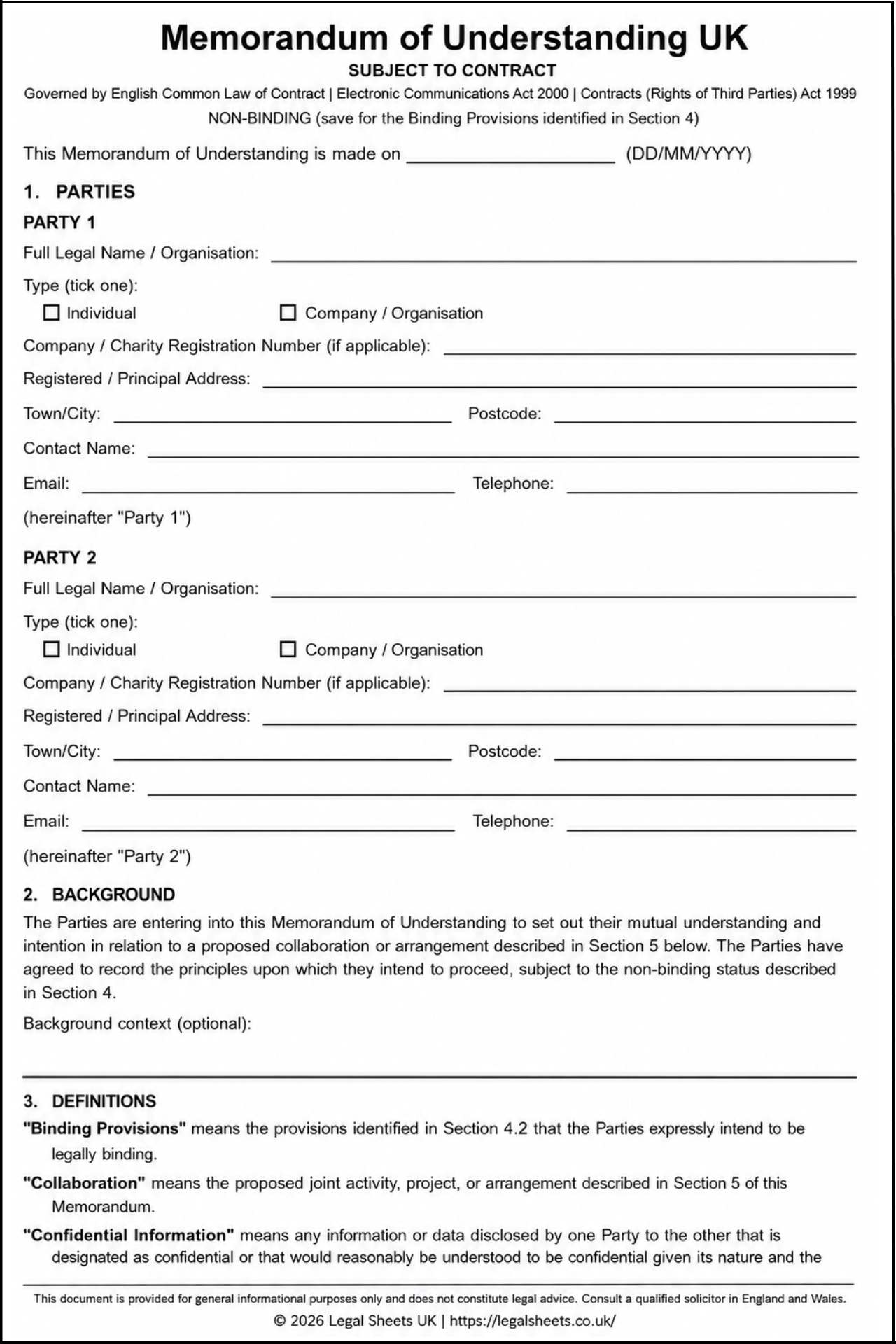
When a Memorandum of Understanding Is Used
Businesses use Memoranda of Understanding in many different commercial situations. The document creates a written record of discussions while leaving room for negotiations before a final agreement is prepared.
Early-stage business negotiations
Many commercial negotiations begin with broad discussions rather than detailed contractual terms. At this stage, both parties may agree on the overall direction of the project but still need to negotiate pricing, risk allocation, technical requirements, or delivery arrangements.
An MoU allows those discussions to be documented without committing either side to the full transaction. Recording the agreed commercial objectives also reduces misunderstandings as negotiations progress.
Businesses commonly use an MoU where legal advisers, accountants, lenders, or investors still need to review the proposed transaction before definitive contracts are signed.
Joint ventures
Joint venture negotiations often involve significant planning before the parties decide on the final business structure. They may need to agree how resources will be shared, who will manage the project, expected financial contributions, and future ownership arrangements.
Rather than drafting a complex joint venture agreement immediately, many organisations first prepare an MoU outlining the proposed collaboration. This allows negotiations to continue while each party completes financial, technical, or commercial due diligence.
Where confidential information is exchanged during these discussions, binding confidentiality provisions are frequently included even though the commercial objectives remain non-binding.
Commercial collaborations
Businesses regularly collaborate without creating a new company. Examples include marketing partnerships, technology development, manufacturing arrangements, or strategic alliances.
An MoU can record the purpose of the collaboration, expected contributions, decision-making processes, and intended timetable. If negotiations later change direction, the parties can revise or replace the document without renegotiating an entire commercial contract.
This flexibility is one reason MoUs remain popular during lengthy negotiations involving multiple stakeholders.
Supplier or service discussions
Changing suppliers or appointing a new service provider often requires detailed commercial discussions before a final contract is ready.
An MoU allows both organisations to record their intentions while technical specifications, pricing models, service levels, or procurement approvals continue.
Many companies also use this stage to exchange commercially sensitive information. Where that happens, confidentiality clauses are usually drafted as binding obligations to protect business information if negotiations later fail.
Research or development projects
Research collaborations frequently begin long before intellectual property ownership, funding arrangements, or commercial exploitation rights have been finalised.
Universities, technology businesses, healthcare organisations, and private companies often use an MoU to document their initial understanding while detailed legal agreements are negotiated.
Because valuable intellectual property may be created or disclosed during the project, careful drafting is essential. The parties normally identify which intellectual property provisions should remain legally enforceable from the outset instead of waiting until the final agreement is signed.
Property or investment negotiations before formal contracts
Commercial property acquisitions and investment projects often involve lengthy negotiations before legally binding contracts are completed.
An MoU may record the commercial understanding between the parties while surveys, funding arrangements, planning issues, or legal investigations continue.
However, additional care is required where the document is intended to create binding obligations relating to land. If any part of the MoU is intended to operate as a contract for the sale or disposition of an interest in land, it must satisfy the formal requirements of Section 2 of the Law of Property (Miscellaneous Provisions) Act 1989. Failing to meet those requirements can leave the relevant property provisions entirely unenforceable
Why Businesses Choose a Memorandum of Understanding Instead of a Contract
An MoU is not a substitute for a commercial contract. Instead, it fills the gap between informal negotiations and the point at which the parties are ready to sign legally binding agreements.
Recording commercial intentions
Commercial negotiations often develop over weeks or months. During that period, verbal discussions can easily be misunderstood or remembered differently by each party.
An MoU creates a written record of the agreed commercial direction without requiring every contractual detail to be finalised immediately. That record gives negotiators a common reference point as discussions continue.
It also reduces the likelihood of repeated negotiations over issues that have already been broadly agreed.
Allowing negotiations to continue
Business transactions rarely progress in a straight line. Funding may change, technical requirements may evolve, or additional due diligence may reveal issues that require renegotiation.
Using an MoU allows the parties to continue discussing those matters without constantly rewriting legally binding contracts.
If negotiations ultimately break down, each side can generally walk away from the proposed transaction, provided the document clearly states that the commercial terms are not intended to create legal obligations.
Identifying which clauses are intended to be binding
One of the most valuable drafting features of an MoU is the ability to separate legally enforceable provisions from non-binding commercial objectives.
In practice, businesses often choose to make clauses dealing with confidentiality, intellectual property, exclusivity, governing law, or negotiation costs legally binding while leaving the proposed transaction itself non-binding.
Without that distinction, disputes can arise over whether confidential information may be used after negotiations end or whether exclusivity obligations remain enforceable. Clear drafting significantly reduces those arguments.
Avoiding accidental contractual commitments
Many commercial disputes begin because businesses assume an MoU has no legal effect. English courts do not rely solely on the document’s title. Instead, they examine the wording used and the behaviour of the parties after signing.
Where an MoU contains all of the essential contractual terms and the parties begin performing the proposed transaction, a court may conclude that a legally binding contract has been created despite the document being described as a Memorandum of Understanding. That risk becomes greater if the document omits clear “Subject to Contract” or non-binding wording.
For that reason, experienced commercial advisers usually review both the drafting and the practical conduct of the parties throughout negotiations rather than focusing only on the document itself.
Clauses Commonly Included in a Memorandum of Understanding
Although every Memorandum of Understanding is tailored to the proposed transaction, most commercial MoUs include similar operational clauses. Each clause should reflect the purpose of the negotiations while making it clear whether it is intended to be legally binding.
Parties
The document should accurately identify every organisation or individual involved in the proposed arrangement. Incorrect legal names or incomplete party details can create unnecessary uncertainty later in the negotiation process.
Where businesses operate through group companies, it is particularly important to identify the correct contracting entity rather than simply referring to a trading name.
Purpose of the Arrangement
This section explains why the parties are entering into the Memorandum of Understanding and what they hope to achieve.
Rather than using broad statements, the purpose should describe the proposed collaboration clearly enough that both parties understand the commercial objective without creating unintended contractual obligations.
Commercial Objectives
The commercial objectives describe the expected outcome of the negotiations.
These may include developing a product, providing services, investing in a project, sharing technology, or exploring a future business opportunity. The wording should remain flexible because negotiations frequently evolve before definitive agreements are signed.
Roles and Responsibilities
An MoU often records the anticipated responsibilities of each party during the negotiation period.
Examples include providing technical information, conducting due diligence, arranging funding discussions, or preparing draft agreements. Clearly recording these expectations can reduce disagreements over who is responsible for each stage of the project.
Timetable and Milestones
Negotiations can lose momentum without agreed target dates.
Including a timetable allows the parties to monitor progress towards key milestones, such as completing due diligence, exchanging financial information, or preparing formal contracts. These dates are often indicative rather than legally binding unless expressly stated otherwise.
Confidentiality
Businesses frequently disclose commercially sensitive information during negotiations. A confidentiality clause identifies the information that must remain confidential and explains how it may be used.
Under English common law, confidentiality provisions may remain legally enforceable even where the wider commercial objectives are expressly stated to be non-binding. That distinction often becomes critical if negotiations collapse after sensitive information has already been exchanged.
Exclusivity (if applicable)
Some negotiations require one or both parties to avoid negotiating with competitors for a limited period.
To be enforceable, an exclusivity or lock-out provision must specify a fixed duration and either be supported by contractual consideration or be executed as a deed. If those requirements are not satisfied, the clause may fail entirely despite appearing in the Memorandum of Understanding.
Intellectual Property
Where research, technology, software, branding, or other intellectual property is discussed, the MoU should clarify how existing and newly created intellectual property will be treated during negotiations.
This reduces the risk of later disputes over ownership if confidential ideas or commercially valuable information are shared before a final agreement is completed.
Costs and Expenses
Negotiations often generate legal, financial, and professional costs before any commercial contract is signed.
The MoU may confirm whether each party bears its own costs or whether particular expenses will be shared. Recording this early can prevent disagreements if negotiations end without a completed transaction.
Governing Law and Jurisdiction
Where binding clauses are included, the MoU commonly identifies the governing law and the court that will deal with disputes relating to those provisions.
This creates certainty if enforcement later becomes necessary, particularly where businesses from different jurisdictions are involved.
Signatures
Although there is generally no prescribed statutory format for executing a Memorandum of Understanding under English common law, signatures demonstrate that both parties have agreed to the document’s contents.
Before signing, the parties should review the wording carefully to confirm that binding and non-binding provisions have been clearly separated. That final review often prevents the drafting issues that become the focus of later commercial disputes.