
Cohabitation Contract UK – PDF & Fillable Template
A Cohabitation Agreement is often sought after couples realise that simply living together in England does not create the legal protections many people expect. That misunderstanding frequently surfaces only after a separation, when the County Court is asked to determine property interests under the Trusts of Land and Appointment of Trustees Act 1996 using bank records, contributions and other evidence rather than clear written intentions.
A carefully prepared agreement records those arrangements while the relationship is working well, instead of leaving them to be reconstructed during a dispute. If you’re moving into a shared home, buying property together or bringing significant assets into the relationship, the template and completion guidance that follow offer wording designed for those practical circumstances.
Cohabitation Agreement Template (PDF, Word & Printable Formats)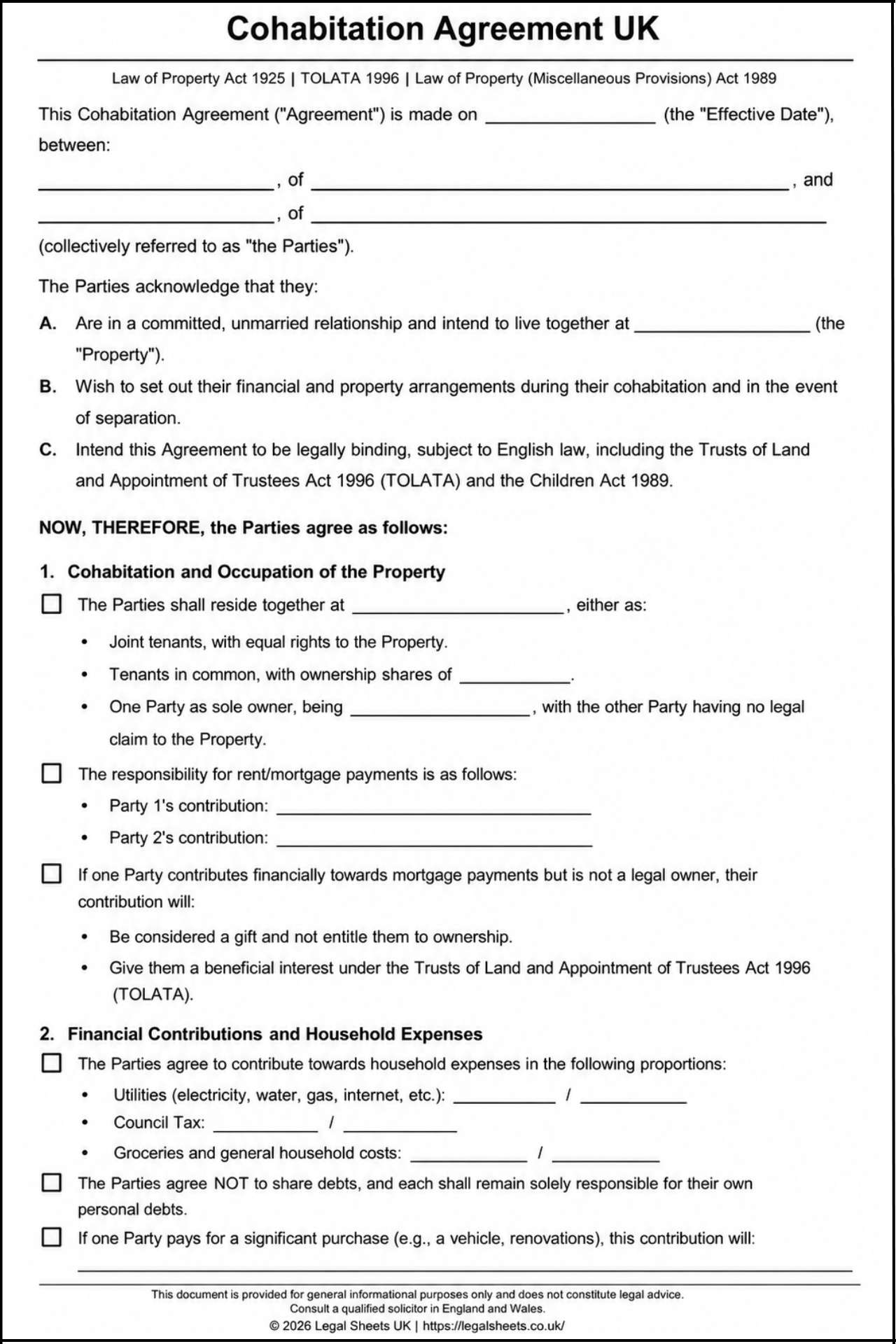
Situations Where a Cohabitation Agreement Becomes Necessary
Buying a Home Together
Buying property is one of the most common reasons couples prepare a Cohabitation Agreement. Although ownership may be recorded at HM Land Registry, it does not always explain how mortgage payments, deposits or future equity should be divided if each partner contributes different amounts.
One Partner Already Owns the Property
Many couples live in a home already owned by one partner before the relationship begins. Questions often arise later about mortgage contributions, renovation costs and whether those payments created any ownership interest. Recording expectations from the beginning greatly reduces uncertainty.
Sharing Mortgage Payments Unequally
Equal ownership does not always reflect unequal financial contributions. One partner may provide the entire deposit while the other contributes towards monthly mortgage payments. Recording these arrangements alongside any Declaration of Trust can provide valuable evidence if ownership is later disputed.
Living Together in a Rented Property
A living together agreement can also be useful where the couple rents rather than owns a property. It can record responsibility for rent, household bills, furniture purchases and other shared expenses without relying upon informal conversations.
Protecting Savings, Investments and Personal Assets
Many people enter a relationship with savings, investments or valuable possessions accumulated before living together. Recording ownership of these assets helps distinguish them from jointly acquired property.
Planning for Separation Before Problems Arise
Preparing an agreement while the relationship is positive usually produces clearer and more balanced discussions than attempting to negotiate after separation has already occurred. Decisions made calmly are often easier to understand and document than those made during conflict.
What Should a Cohabitation Agreement Include?
Names and Details of the Partners
The agreement should accurately identify each partner together with their addresses and the date the agreement takes effect. Accurate identification reduces uncertainty if the document is relied upon years later.
Property Ownership Arrangements
Where the agreement addresses ownership of land or property, careful drafting becomes particularly important. Under the Law of Property Act 1925, declarations concerning beneficial ownership should be recorded in writing. If ownership is left unclear, disputes may instead depend upon complex implied trust principles.
Mortgage and Household Contributions
The agreement should record who pays the mortgage, council tax, utilities, insurance and maintenance costs. It should also explain how future changes to those contributions will be handled.
Bank Accounts and Shared Expenses
Many couples keep separate finances while sharing household costs. The agreement can record whether bank accounts remain separate, whether a joint account will be used and how regular expenses will be divided.
Ownership of Furniture, Vehicles and Personal Belongings
Furniture, vehicles, electronics and valuable personal belongings often become disputed after separation because purchase records are no longer available. Listing ownership within the agreement provides useful evidence if disagreements later arise.
Existing Debts and Future Liabilities
The agreement should distinguish debts that existed before cohabitation from those incurred jointly afterwards under loan agreements. This helps avoid arguments over responsibility for loans or credit card balances.
Pets
Pets frequently become an emotional source of disagreement. Recording ownership together with responsibility for veterinary expenses, insurance and ongoing care can reduce uncertainty if the relationship ends.
Gifts and Inheritances
Couples often wish to confirm that gifts or inheritances received individually remain separate property unless expressly shared.
What Happens If the Relationship Ends
The agreement should explain how jointly owned property, household contents and financial responsibilities will be dealt with if cohabitation comes to an end.
Reviewing or Updating the Agreement
Major life events such as purchasing another property, having children or making substantial financial investments should prompt a review so the agreement continues to reflect the couple’s intentions.
Execution Requirements That Matter
Why the Agreement Should Normally Be Executed as a Deed
Because a Cohabitation Agreement may not involve contractual consideration in the traditional sense, it is commonly executed as a deed. Section 1 of the Law of Property (Miscellaneous Provisions) Act 1989 requires specific execution formalities, including independent witnessing. Failure to follow those formalities can weaken the document if enforcement later becomes necessary.
Independent Witness Requirements
Each signature should normally be witnessed by an independent adult who is physically present when the document is signed. An incomplete witness section may later create unnecessary arguments over whether the agreement was properly executed.
Financial Disclosure Before Signing
Although England does not impose a statutory financial disclosure requirement for Cohabitation Agreements, openly recording assets, liabilities and financial commitments significantly reduces the likelihood of later allegations that one partner entered the agreement without full knowledge of the other’s financial position.
Why Independent Legal Advice Is Strongly Recommended
Independent legal advice is not compulsory, but it can become highly persuasive evidence if one partner later argues they misunderstood the document or signed because of pressure or undue influence.
Common Drafting Mistakes That Cause Problems Later
Assuming “Common Law Marriage” Exists
The concept of ‘common law marriage’ is a complete legal myth in England. No matter if you have cohabited for 3 years or 30 years, unmarried couples acquire absolutely zero automatic rights to their partner’s property, pension, or income upon separation. Consequently, disputes fall entirely outside the discretionary ‘fairness’ framework of the Family Court and are decided instead by the rigid, expensive application of civil contract and property law.
Failing to Record Unequal Property Shares
If one partner contributes substantially more towards a deposit or mortgage but the agreement says nothing about ownership, later disputes can become significantly more complicated and expensive.
Leaving Property Clauses Too Vague
General statements about sharing property “fairly” often create more questions than answers. Practical percentages, ownership arrangements and contribution records usually provide stronger evidence.
Signing Without Proper Witnessing
Where execution as a deed is intended, missing witness signatures or incorrect execution formalities may undermine reliance upon the agreement.
Hiding Assets or Debts
Failing to disclose significant financial information increases the risk of later allegations of misrepresentation and may affect the credibility of the agreement if challenged.
Including Child Maintenance Clauses That Cannot Be Enforced
Parents cannot remove statutory child maintenance obligations through a private agreement.Under the Child Support Act 1991, responsibility for child maintenance remains subject to statutory rules regardless of any clause attempting to exclude those obligations..
England Legal Requirements
Legal Requirements Table
| Topic / Issue | Precise English Legal Rule | Governing Statute / Precedent |
| Execution as a Deed | Because Cohabitation Agreements often lack formal “consideration,” they must be executed as a deed (requiring independent witnesses) to guarantee contractual enforceability. | Law of Property (Miscellaneous Provisions) Act 1989 (Section 1) |
| Beneficial Ownership | Any clause declaring how the equity in a shared home is split acts as an express declaration of trust and must be in writing and signed to be valid. | Law of Property Act 1925 (Section 53(1)(b) |
| Property Dispute Resolution | The court’s power regarding cohabiting couples is strictly limited to declaring who owns what and forcing a sale; judges cannot reallocate assets based on “fairness.” | Trusts of Land and Appointment of Trustees Act 1996 (TOLATA) |
| Child Maintenance | Private agreements cannot extinguish statutory child maintenance obligations. Any clause attempting to block future child support claims is legally void. | Child Support Act 1991 (Section 9) |
| Children’s Housing/Needs | Cohabitation Agreements cannot ban a partner from applying to the court for housing provision or lump sums specifically for the benefit of a minor child. | Children Act 1989 (Schedule 1) |
| Contract Validity | The agreement is governed by standard contract and trust law principles and can be set aside if signed under duress, undue influence, or material misrepresentation. | Common Law |
Practical Legal Impact
These legal rules become particularly significant if the agreement is later challenged. Property disputes between unmarried couples are generally determined through ordinary civil litigation rather than the Family Court’s discretionary financial remedy process available on divorce following separation. Claims involving ownership of a home commonly proceed under the Trusts of Land and Appointment of Trustees Act 1996, where the court examines written evidence carefully. A properly drafted agreement supported by clear financial records is usually far easier to interpret than conflicting recollections of verbal discussions made many years earlier.
What Happens If the Agreement Is Challenged?
County Court and High Court Proceedings
Disputes concerning a Cohabitation Agreement are generally resolved through the County Court or, in more substantial cases, the High Court. The court considers the wording of the agreement together with other available evidence.
TOLATA Property Claims
When property disputes escalate, they are litigated in the civil courts under the Trusts of Land and Appointment of Trustees Act 1996 (TOLATA). Unlike Family Court judges in a divorce, civil judges cannot redistribute property based on ‘fairness’ or ‘needs’. Their power is strictly limited to declaring existing property rights and ordering a sale. If your Cohabitation Agreement contains a validly executed express declaration of trust, the TOLATA judge is legally bound to enforce those exact ownership percentages.
Undue Influence Allegations
If one partner claims they were pressured into signing without sufficient opportunity to obtain independent legal advice, the court may examine whether undue influence affected the agreement.
Misrepresentation Claims
An agreement may also be challenged where one partner alleges that significant assets, liabilities or financial information were deliberately concealed before signing.
When a Court May Refuse to Enforce Certain Clauses
Not every provision within a Cohabitation Agreement is legally enforceable. Any clause attempting to oust the jurisdiction of the Child Maintenance Service under Section 9 of the Child Support Act 1991 is entirely void. Furthermore, parents cannot legally contract out of their liability to provide housing or lump sums for the benefit of a minor child under Schedule 1 of the Children Act 1989; the court retains absolute statutory authority to make these orders regardless of your private agreement.
Frequently Asked Questions
Can an unmarried couple make a Cohabitation Agreement after moving in together?
Yes. Many couples prepare the agreement after they have already begun living together, although preparing it before purchasing property or combining finances often provides greater certainty.
Does a Cohabitation Agreement override ownership shown at HM Land Registry?
Yes, regarding beneficial ownership. Under strict English case law (Goodman v Gallant), if your Cohabitation Agreement contains an express declaration of trust that complies with Section 53(1)(b) of the Law of Property Act 1925, that written division of equity is legally conclusive. It definitively overrides the default ownership assumptions of the legal title registered at HM Land Registry, binding the court unless successfully challenged for fraud, mistake, or a subsequent variation.
Can the agreement prevent future child maintenance claims?
No. A private agreement cannot remove statutory child maintenance obligations under the Child Support Act 1991.
Should each partner obtain independent legal advice before signing?
Although not compulsory, independent legal advice may strengthen the agreement if its validity is later questioned.
Can a Cohabitation Agreement be updated if our circumstances change?
Yes. Couples frequently review the agreement after purchasing property, receiving an inheritance, having children or making significant financial changes so that it continues to reflect their current arrangements.