
Living Will Template UK (PDF & Word)
People often begin looking for a Living Will after discussing future medical care with family or receiving advice from a healthcare professional, only to discover that an informal statement of wishes may not be recognised if mental capacity is later lost. In England, where a Living Will is intended to operate as an Advance Decision to Refuse Treatment under the Mental Capacity Act 2005, documents dealing with life-sustaining treatment must meet specific signing, witnessing and wording requirements before clinicians can rely upon them.
Difficulties commonly arise when a document contains only general healthcare preferences, leaving NHS professionals unable to follow it and, in some cases, requiring the Court of Protection to resolve uncertainty about the patient’s wishes. The template, example wording and completion guidance that follow are designed to help you prepare a document that reflects the formal requirements expected in England.
Living Will Template (PDF, Word & Printable Formats)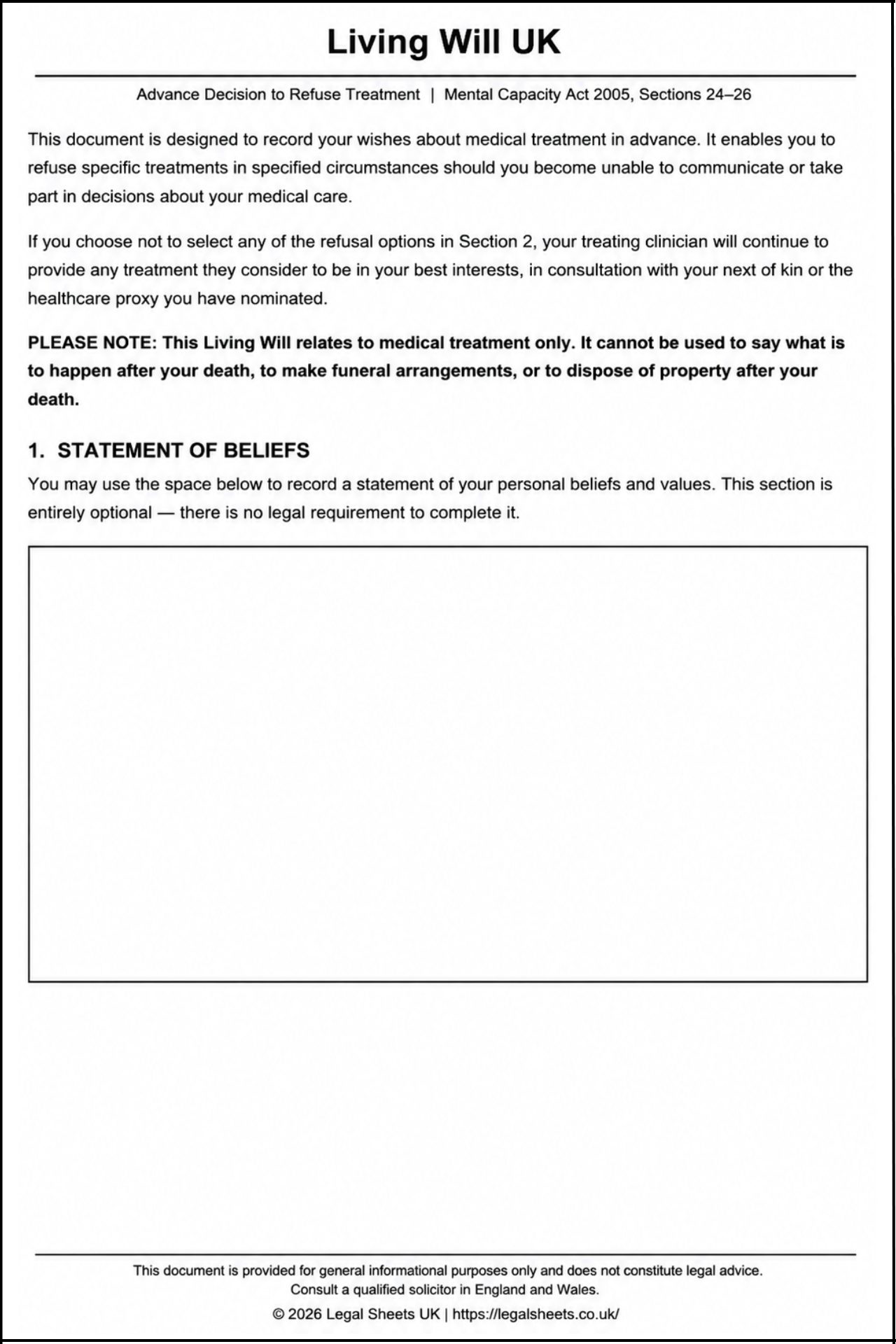
When a Living Will May Be the Right Choice
Many people assume a Living Will is only appropriate during the later stages of life, but that is rarely the case. Serious illness, planned surgery, progressive neurological conditions and long-term medical treatment often prompt individuals to record their wishes well before capacity becomes an issue. Preparing the document while you fully understand the decisions being made is central to its effectiveness under the Mental Capacity Act 2005.
Unlike documents that appoint someone else to make decisions, a Living Will allows you to decide in advance which treatments you do not wish to receive if specified medical circumstances arise. Healthcare professionals can then consider those instructions if you later lose capacity.
Situations Where a Living Will Is Commonly Used
A Living Will may be appropriate where someone wishes to refuse certain treatments in advance because of:
- Progressive neurological conditions.
- Terminal illness.
- Serious chronic disease.
- Major surgery carrying significant risks.
- Personal or religious beliefs affecting medical treatment.
- Concerns about prolonged life-sustaining treatment.
It may also be appropriate for individuals who simply want their healthcare preferences recorded while they remain capable of making informed decisions.
When a Living Will May Not Be Appropriate
A Living Will is not suitable for every healthcare decision. It cannot be used to demand that doctors provide particular treatments, nor can it require healthcare professionals to act contrary to their clinical judgement. Likewise, it cannot be used to request assisted dying or euthanasia, which remain unlawful in England.
Where someone wishes another individual to make healthcare decisions on their behalf, a Health and Welfare Lasting Power of Attorney is generally the more appropriate document.
Documents That May Be Needed Alongside a Living Will
Depending on your circumstances, you may also wish to prepare:
- Health and Welfare Lasting Power of Attorney
- Advance Statement
- Do Not Attempt Cardiopulmonary Resuscitation (DNACPR) Decision
- Will
- Organ Donation Decision
Each serves a different purpose and should not be treated as a substitute for a Living Will.
Understanding What a Living Will Can and Cannot Do
Many misunderstandings arise because people believe a Living Will controls every aspect of future healthcare. In reality, it has a much narrower function. It enables you to refuse specified medical treatments if clearly defined circumstances arise after you have lost mental capacity.
Healthcare professionals remain responsible for assessing whether the document is valid and whether it applies to the clinical situation before them. If there is genuine uncertainty, treatment may continue while those questions are resolved.
Treatments You Can Refuse
A Living Will may refuse specific medical treatments, provided they are described clearly enough for healthcare professionals to understand exactly what is being refused and under which circumstances.
Examples include:
- Artificial ventilation.
- Cardiopulmonary resuscitation in specified situations.
- Artificial nutrition or hydration where legally appropriate.
- Certain life-sustaining treatments.
- Other specified medical interventions.
The more precisely the treatment and circumstances are described, the easier it becomes for clinicians to determine whether the document applies.
Decisions That Cannot Be Included
A Living Will cannot:
- Require doctors to provide treatment.
- Require treatment that conflicts with clinical judgement.
- Request assisted suicide or euthanasia.
- Require healthcare professionals to ignore applicable law.
Any wording attempting to achieve these outcomes will not be legally effective.
How a Living Will Differs From an Advance Statement
People frequently confuse these two documents because both relate to future healthcare.
A Living Will records treatments that you refuse in advance and may become legally effective if the statutory requirements are met.
An Advance Statement is different. It records your personal wishes, preferences, beliefs and values but does not operate as a refusal of treatment. Healthcare professionals should consider it when making decisions, but it does not have the same legal effect as a valid Advance Decision to Refuse Treatment.
How a Living Will Differs From a Health and Welfare Lasting Power of Attorney
These documents are often prepared together but serve different purposes.
A Living Will records treatment decisions that you have already made for yourself.
A Health and Welfare Lasting Power of Attorney appoints another person to make certain healthcare decisions if you lose mental capacity.
One of the most significant practical issues arises where a later Health and Welfare Lasting Power of Attorney gives the attorney authority to consent to or refuse the same treatment covered by an earlier Living Will. Under the Mental Capacity Act 2005, the later LPA may override the earlier Advance Decision for those overlapping decisions.
Before You Prepare a Living Will
Most problems arise long before the document is signed. Many people focus on completing the form without carefully considering the medical situations it is intended to cover. Vague instructions or unrealistic expectations often create uncertainty for clinicians when the document is eventually relied upon.
Preparing the document thoughtfully is usually far more important than completing it quickly.
Mental Capacity Requirements
Under the Mental Capacity Act 2005, you must have mental capacity when making the Living Will. This means you must understand the treatment decision being made and its likely consequences.
If capacity is questioned later, healthcare professionals may need to consider whether the document was created while you were capable of making that particular decision.
Age Requirements
Only adults aged 18 or over may create a valid Advance Decision to Refuse Treatment under the Mental Capacity Act 2005.
Preparing the document before reaching that age will not satisfy the statutory requirements.
Considering Future Medical Circumstances
Many documents become difficult to apply because they refer only to being “seriously ill” or “critically unwell.”
Instead, consider the specific clinical situations in which you want the refusal to operate. Clear descriptions make it much easier for doctors to determine whether your decision applies to your actual medical condition.
Discussing Your Wishes With Healthcare Professionals
Although not legally required in every case, discussing your decisions with your GP or specialist can reduce uncertainty later.
Healthcare professionals may identify wording that is too broad or explain how particular treatments are used in practice. These discussions can make the document more useful if it ever needs to be relied upon during emergency care.
Talking to Family Members and Attorneys
Family members are often the first people approached when urgent treatment decisions arise. If they are unaware that a Living Will exists, valuable time may be lost locating the document.
Where you also have a Health and Welfare Lasting Power of Attorney, it is sensible to ensure your attorney understands the existence of the Living Will and how the two documents interact. Clear communication can prevent confusion during emotionally difficult situations and reduce the likelihood of disputes about your intended medical wishes.
Key Decisions Before Completing the Document
Completing a Living Will involves more than recording general healthcare wishes. The document must clearly identify the treatments you intend to refuse and the medical circumstances in which those refusals apply. Unclear wording frequently causes problems because healthcare professionals must decide whether the document applies to the situation they are facing.
Choosing Which Treatments to Refuse
Think carefully about each treatment you wish to refuse rather than making broad statements. General phrases such as “I refuse all treatment” are unlikely to assist clinicians because they do not identify the specific intervention being refused.
Many people choose to address treatments such as artificial ventilation, cardiopulmonary resuscitation or artificial nutrition only in clearly defined circumstances rather than refusing every possible medical intervention.
Refusing Life-Sustaining Treatment
Additional formalities apply where the refusal relates to life-sustaining treatment. Under the Mental Capacity Act 2005, the document must contain a clear statement confirming that the refusal is intended to apply even if life is at risk.
If this declaration is omitted, healthcare professionals cannot rely upon the document when deciding whether to provide life-sustaining treatment.
Specifying the Circumstances in Which the Decision Applies
Refusing treatment without explaining when the refusal should operate often creates uncertainty.
Instead of referring simply to serious illness, identify the medical circumstances as clearly as possible. The more specific the description, the easier it becomes for clinicians to determine whether the Living Will applies to your condition at the time treatment is being considered.
Avoiding Ambiguous Medical Instructions
Ambiguous wording is one of the most common reasons an Advance Decision becomes difficult to apply.
Avoid statements that leave healthcare professionals guessing what was intended. Precise treatment descriptions and clearly defined medical situations provide greater certainty if the document is later relied upon.
Information You’ll Need Before Completing the Form
Preparing the necessary information before writing the document usually results in a clearer and more effective Living Will.
Personal Details
Record your full legal name, address, date of birth and any additional identifying information that may assist healthcare providers in confirming the document belongs to you.
Medical Conditions (If Relevant)
Although not mandatory, referring to existing medical conditions may assist in explaining why certain treatment refusals have been made.
Treatment Refusals
Clearly identify every treatment you intend to refuse.
Avoid broad descriptions wherever possible.
Clinical Circumstances
Describe the medical situations in which each refusal should apply.
Specific clinical circumstances make the document significantly easier to interpret.
Witness Information
Where life-sustaining treatment is refused, the witness should complete the relevant witnessing requirements as required by the Mental Capacity Act 2005.
Completing a Living Will Correctly
The wording should be clear enough for healthcare professionals to understand without making assumptions.
Writing Clear Treatment Refusals
Each refusal should identify:
- The treatment being refused.
- The medical circumstances.
- Whether the refusal applies permanently or only in particular situations.
Using the Required Statement for Life-Sustaining Treatment
Where life-sustaining treatment is refused, the document must contain wording confirming that the refusal applies “even if life is at risk” or words having the same legal effect.
Without this statement, the refusal will not satisfy the statutory requirements.
Signing the Document
For refusals involving life-sustaining treatment, the Living Will must be signed by the maker or by another person acting in the maker’s presence and under their direction.
Witness Requirements
The signature must be made or acknowledged in the physical presence of at least one witness, who must also sign the document in the maker’s presence.
Failure to complete these execution requirements means the document will not operate as a valid refusal of life-sustaining treatment.
Dating the Document
Dating the Living Will provides useful evidence of when it was created and assists healthcare professionals in determining whether a later document may have replaced it.
Mistakes That Commonly Make a Living Will Ineffective
Many disputes do not arise because the document was ignored, but because healthcare professionals could not be satisfied that it met the statutory requirements.
Using Vague Language
General statements such as “I refuse extraordinary treatment” often provide insufficient guidance.
The document should identify both the treatment and the circumstances with reasonable certainty.
Missing the Required Life-Sustaining Treatment Statement
Failure to include the statutory declaration for life-sustaining treatment is one of the most significant drafting errors.
Without it, clinicians will generally continue treatment in accordance with the patient’s best interests.
Failing to Sign or Witness the Document Correctly
Where the execution formalities are incomplete, the document may not operate as a valid Advance Decision for life-sustaining treatment.
Trying to Demand Medical Treatment
An Advance Decision operates exclusively as a legal shield to refuse care; it cannot legally compel doctors to provide a specific treatment contrary to their clinical judgment. Furthermore, English law strictly prohibits using a Living Will to request assisted dying or euthanasia, which remains a criminal offence under the Suicide Act 1961.
Contradicting Later Decisions or Actions
The document may become invalid if your later behaviour clearly demonstrates that you changed your mind.
Under Section 25(2)(c) of the Mental Capacity Act 2005, your Advance Decision becomes legally void if you subsequently do anything ‘clearly inconsistent with the advance decision remaining a fixed decision’—such as verbally requesting the refused intervention or embracing beliefs that strictly prohibit the refusal of medical care.
How a Living Will Works in Practice
The document only becomes relevant if you lose the mental capacity to make the treatment decision yourself.
Healthcare professionals must first determine whether the Living Will is valid and whether it applies to the particular clinical circumstances.
How Doctors Decide Whether It Applies
Doctors consider:
- Whether you had capacity when creating the document.
- Whether the refusal clearly applies to the treatment being considered.
- Whether the circumstances described have arisen.
- Whether the document has been revoked or replaced.
Only when these issues are satisfied will the refusal generally be followed.
When Healthcare Professionals May Disregard It
Clinicians may decide not to rely upon the document where:
- There is genuine doubt about validity.
- The circumstances are not covered.
- The wording is ambiguous.
- Later actions suggest you changed your decision.
Medical Emergencies
Emergency treatment frequently takes place within minutes.
If doctors or paramedics are unaware that a Living Will exists, they are legally protected in providing life-saving treatment while acting in the patient’s best interests.
For this reason, simply signing the document is rarely enough. The people involved in your care need to know it exists.
Court of Protection Disputes
Under Section 26(4) of the Mental Capacity Act 2005, if severe clinical doubt or family disputes arise regarding the validity of the Advance Decision or its applicability to an unanticipated medical crisis, the treating NHS Trust or family must apply directly to the Court of Protection for a binding legal declaration
Storing and Sharing Your Living Will
A properly drafted document has little practical value if nobody can locate it during a medical emergency.
Keeping the Original Document Safe
Store the original in a secure location where it can be accessed quickly if required.
Giving Copies to Your GP
Providing a copy to your GP allows the Advance Decision to be formally coded onto your NHS Summary Care Record (SCR) and integrated into regional digital shared care networks. This ensures that paramedics and out-of-hours NHS clinicians can instantly verify your legally binding refusals during an emergency.
Sharing Copies With Hospitals
If you receive ongoing hospital treatment, consider providing copies to the relevant clinical team so they are aware of your wishes.
Informing Family Members
Family members should know that the document exists and understand where it is kept.
This can prevent delays during urgent medical situations.
Reviewing the Document Regularly
Review the Living Will periodically, particularly if your health, medical treatment or personal wishes change.
Changing or Cancelling a Living Will
Your wishes may change over time.
The Mental Capacity Act 2005 allows an Advance Decision to be altered or withdrawn while you continue to have mental capacity.
Making Amendments
Significant changes are usually better recorded in a new document than through handwritten amendments that may create uncertainty.
Revoking the Document
You may withdraw the Living Will at any time while you have mental capacity.
The withdrawal does not have to be in writing, although keeping clear records can reduce confusion later.
Creating a Replacement Living Will
If your medical wishes change substantially, creating a replacement document is often the clearest approach.
Destroying outdated copies can prevent conflicting instructions.
When a Later Health and Welfare LPA Takes Priority
Under Section 25(2)(b) of the Mental Capacity Act 2005, executing a subsequent Health and Welfare Lasting Power of Attorney automatically invalidates an earlier Living Will, but only if the new LPA explicitly grants the attorney the power to give or refuse consent to the exact treatment covered by your Advance Decision.
UK Legal Requirements Affecting a Living Will
Legal Requirements Table
| Topic / Issue | Precise English Legal Rule | Governing Statute / Administrative Regulation |
| Capacity & Age Requirement | The maker must be aged 18 or over and possess the mental capacity to make the specific treatment decision at the time of creation. | Mental Capacity Act 2005 (Section 24(1)) |
| Refusal of Life-Sustaining Treatment | The document must contain a verified statutory statement that the decision applies to the specified treatment “even if life is at risk.” | Mental Capacity Act 2005 (Section 25(5)) |
| Execution Formalities | A refusal of life-sustaining treatment must be in writing, signed by the maker, and made or acknowledged in the physical presence of at least one witness who must also sign. | Mental Capacity Act 2005 (Section 25(6)) |
| LPA Override | A later Health and Welfare LPA automatically invalidates an earlier Advance Decision if it explicitly gives the attorney the power to consent to or refuse the same treatment. | Mental Capacity Act 2005 (Section 25(2)(b)) |
| Inconsistent Actions | An Advance Decision becomes invalid if the maker does anything “clearly inconsistent” with it remaining their fixed decision. | Mental Capacity Act 2005 (Section 25(2)(c)) |
| Right of Revocation | The maker can alter or withdraw the Advance Decision at any time while they possess mental capacity. Withdrawal does not need to be in writing. | Mental Capacity Act 2005 (Sections 24(3) & 24(4)) |
| Resolution of Disputes | The Court of Protection holds exclusive jurisdiction to make legally binding declarations regarding the validity and clinical applicability of an Advance Decision. | Mental Capacity Act 2005 (Section 26(4)) |
| Prohibition on Demanding Treatment | Advance Decisions can only be used to refuse treatment. Demanding specific medical interventions or assisted dying is legally unenforceable. | Mental Capacity Act 2005 / Suicide Act 1961 |
Practical Legal Impact
Most disputes arise because healthcare professionals cannot confidently determine whether the document applies to the patient’s circumstances rather than because they deliberately ignore it. Vague wording, missing execution formalities or uncertainty about later changes may result in treatment continuing while the patient’s best interests are assessed. Where disagreement cannot be resolved, the Court of Protection has authority to determine whether the Living Will should be followed.
Common Situations Where a Living Will Is Questioned
Disagreements Between Family Members
Relatives may disagree about whether the document reflects your final wishes, particularly if different family members have received different information.
Conflicting Medical Records
Healthcare providers may need to consider whether more recent medical records conflict with the Living Will.
Changes in Religious or Personal Beliefs
Later conduct that clearly indicates a change of mind may affect whether the document remains valid.
Unclear Treatment Instructions
Broad or uncertain wording often creates practical difficulties for clinicians attempting to apply the document to complex medical situations.
FAQ
Can doctors ignore my Living Will?
Doctors may decide not to rely upon a Living Will if there is genuine uncertainty about its validity or whether it applies to the treatment being considered.
Does a Living Will need to be registered in England?
No. A Living Will does not need to be registered with the Office of the Public Guardian or any other public authority to be legally effective.
What happens if I later create a Health and Welfare Lasting Power of Attorney?
A later Health and Welfare Lasting Power of Attorney may override an earlier Living Will where it gives the attorney authority to make the same treatment decisions.
Can I refuse life-sustaining treatment in a Living Will?
Yes, provided the document satisfies the additional statutory requirements, including the required declaration confirming that the refusal applies even if life is at risk.
Can I cancel or replace my Living Will after signing it?
Yes. You may revoke or replace the document at any time while you continue to have mental capacity.
What happens if my Living Will cannot be found during a medical emergency?
If healthcare professionals are unaware that the document exists, they may provide life-saving treatment while acting in your best interests. This is why sharing copies with your GP, relevant healthcare providers and trusted family members is an important practical step.