
Periodic Tenancy Agreement Template (Free Pdf Format)
Many searches for a Periodic Tenancy Agreement begin when a fixed-term tenancy is about to end and neither side wants the arrangement to stop, yet uncertainty quickly arises over notice periods and how the tenancy will continue. One of the most common problems in England is treating a tenancy as if it has automatically rolled forward on agreed terms when the wording does not properly reflect the periodic arrangement created under the Housing Act 1988.
In practice, landlords sometimes discover the issue only after serving notice, with possession proceedings in the County Court becoming more complicated because the agreement and the tenancy’s actual status do not match. The difficulty is rarely the continuation of the tenancy itself; it is the unclear drafting of rent periods, termination rights, and notice provisions that causes disagreement later. If you are moving from a fixed term to an ongoing rental arrangement, the template and guidance that follow can be used to create clear contractual terms that reflect how the tenancy is intended to operate.
Affiliate Disclosure: We may earn a commission from purchases made through affiliate links on this page, at no extra cost to you.
Periodic Tenancy Agreement Template (PDF, Word & Printable Formats)
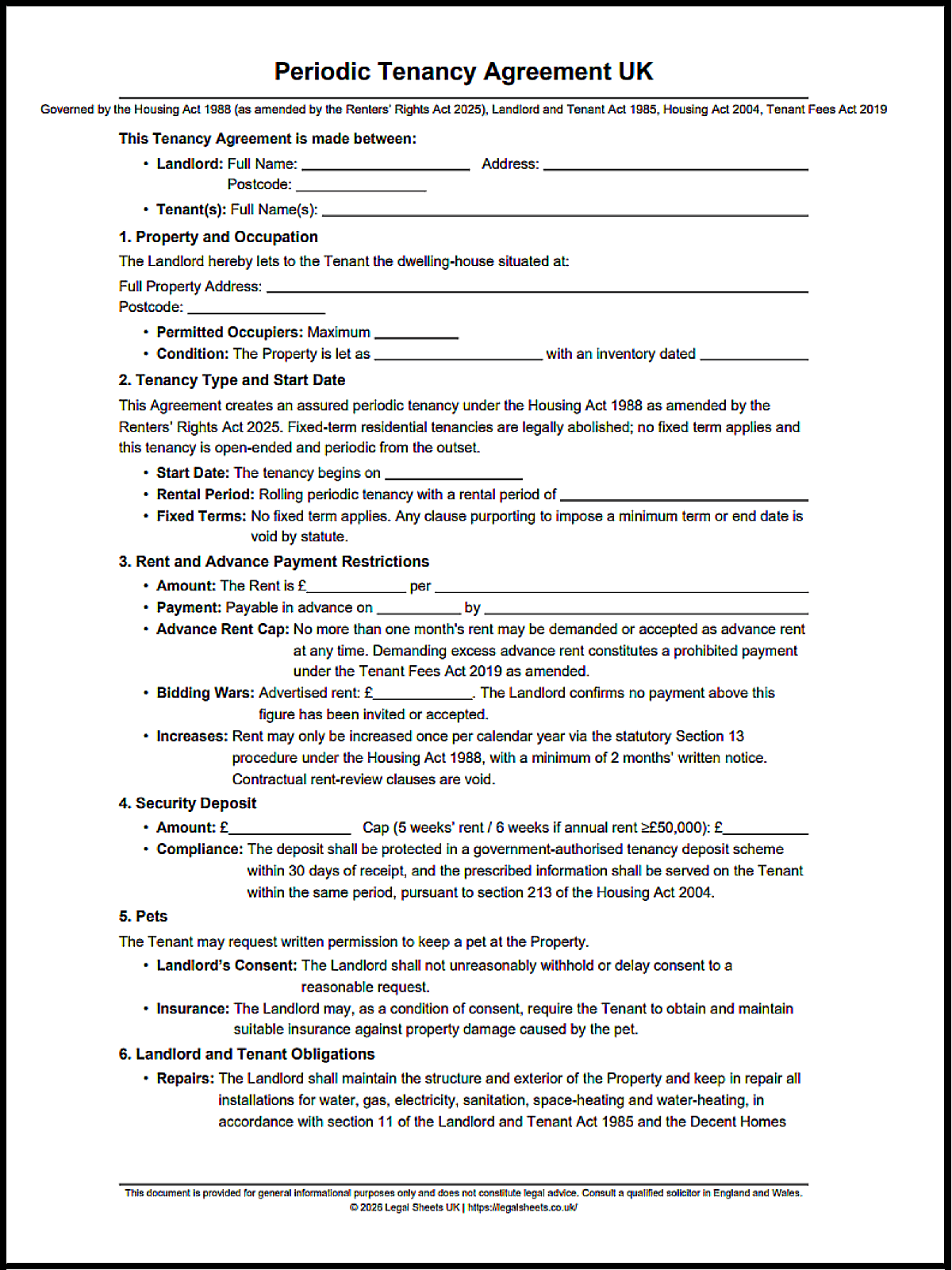
Do-it-yourself Residential Letting/Tenancy Agreement
The Clauses That Changed After Fixed-Term Tenancies Were Abolished
One of the most common drafting mistakes since the 2026 reforms has been the continued use of clauses copied directly from old tenancy agreements.
Many provisions that previously formed the core of residential tenancy contracts are now ineffective because the statutory structure has changed.
Open-Ended Occupation Structure
The tenancy no longer operates around a fixed expiry date.
No fixed end date
The agreement continues until lawfully terminated rather than ending automatically after six or twelve months.
Continuous tenancy model
The occupation runs as a single ongoing tenancy instead of moving through successive fixed terms.
Monthly or shorter rental periods
Under the current framework, the tenancy period generally reflects the rent cycle, commonly monthly but potentially weekly where rent is paid weekly.
For landlords accustomed to fixed-term agreements, this creates a different management approach. Future possession planning now depends heavily on statutory possession grounds rather than waiting for a contractual term to expire.
Clauses That Are Now Legally Void
Some provisions remain surprisingly common despite no longer being enforceable.
Minimum term provisions
Any clause attempting to bind a tenant to a fixed minimum occupation period conflicts with the current tenancy structure and is legally ineffective.
Tenant lock-in periods
Clauses preventing a tenant from exercising statutory notice rights are similarly problematic.
Automatic annual rent review clauses
Contractual rent review mechanisms no longer control rent increases. Rent review wording copied from older agreements frequently creates confusion because rent increases must follow the statutory process.
Blanket pet prohibitions
An absolute prohibition on pets is no longer compatible with the tenant’s statutory right to request permission to keep a pet.
Contractual possession shortcuts
Clauses suggesting that possession can be obtained outside the statutory process often create unrealistic expectations and provide little practical value when enforcement is required.
Terms That Remain Essential
Although many older clauses have disappeared, several provisions remain operationally significant.
Rent due dates
Clear payment dates remain vital for arrears monitoring and record keeping.
Property use restrictions
Landlords continue to rely on use restrictions when addressing unauthorised activities or occupancy issues.
Occupancy limits
Clearly identifying who may occupy the property reduces disputes involving additional residents.
Access arrangements
Inspection and maintenance access provisions remain highly relevant during long-term tenancies.
Deposit terms
Deposit handling continues to generate significant disputes, making clear drafting essential.
Notice procedures
Precise notice provisions often become critical evidence if possession, rent, or termination disputes later arise.
Building a Periodic Tenancy Agreement That Works in Practice
Most tenancy disputes do not originate from unusual legal issues. They arise because ordinary operational matters were not documented clearly enough at the beginning of the tenancy.
A good month to month tenancy agreement UK template focuses heavily on practical administration rather than attempting to predict every possible dispute.
Rent Collection Arrangements
Many future problems can be traced back to unclear payment provisions.
Monthly payment cycles
The agreement should identify precisely when rent falls due and how payments should be made.
Weekly payment cycles
Where rent is paid weekly, the tenancy period and payment structure should align clearly.
Arrears monitoring provisions
Clear payment records become especially important if serious rent arrears later form the basis of a possession claim.
Payment method clauses
Specifying acceptable payment methods reduces disputes over whether rent was actually received.
Landlords who maintain organised payment records generally find it much easier to demonstrate arrears if County Court proceedings eventually become necessary.
Occupancy and Household Changes
Households often change during long-running tenancies.
The agreement should address whether additional adults may move into the property and what notification requirements apply.
Long-term guests
Extended guest stays frequently become contentious where occupancy expectations were never recorded.
Subletting restrictions
Landlords commonly wish to control unauthorised subletting arrangements that alter the risk profile of the property.
Assignment limitations
The agreement should clarify whether tenancy rights may be transferred to another occupier.
Many occupancy disputes develop gradually rather than suddenly. What begins as a temporary arrangement can eventually create uncertainty regarding who is actually entitled to occupy the property.
Property Management Provisions
Property management clauses often receive little attention until something goes wrong.
Access for inspections
Inspection arrangements help landlords monitor property condition and identify repair issues early.
Reporting repairs
A clear reporting process reduces disputes over when defects were first reported.
Emergency access
Emergency situations benefit from clearly documented access rights and communication procedures.
Property condition expectations
Reasonable expectations regarding cleanliness, maintenance, and general property care often reduce friction during long-term occupation.
Where repair disputes later arise, both parties frequently rely on these provisions to demonstrate what was expected and whether those expectations were followed in practice.
Mandatory Written Information That Must Appear in the Agreement
One of the biggest changes introduced by the 2026 tenancy reforms is that landlords are no longer free to rely on a basic tenancy document that only records rent and property details.
For tenancies beginning on or after 1 May 2026, landlords must provide a written statement containing specific tenancy information before the tenancy is entered into. For older oral arrangements that automatically converted into the new tenancy structure, the required information had to be provided by 31 May 2026.
In practice, many compliance failures occur not because landlords deliberately ignore the rules, but because they continue using older templates that omit information now required by statute.
Core Tenancy Information
Certain information forms the foundation of the written tenancy record.
Names and addresses of parties
The document should clearly identify both landlord and tenant. Ambiguity over landlord identity can create difficulties later when notices are served or legal proceedings become necessary.
Property address
The property must be described accurately so there is no uncertainty about the premises covered by the tenancy.
Rent amount and payment dates
Disputes regarding arrears often begin with disagreements about payment timing rather than non-payment itself.
Deposit details
The agreement should record the amount taken and explain how the deposit arrangements operate.
Where this information is missing or inconsistent, evidential problems frequently emerge during possession claims and debt recovery proceedings.
Statutory Rights That Must Be Reflected
The written statement must also reflect certain rights and obligations that now form part of the tenancy framework.
Tenant’s 2-month notice right
The document should explain the tenant’s right to terminate the tenancy by providing the required notice.
Section 13 rent increase procedure
Rent increases now operate through a statutory mechanism rather than contractual review clauses, and the agreement should reflect this reality.
Repair obligations
The landlord’s repairing responsibilities remain a recurring source of disputes and should be addressed clearly.
Rights relating to pets
The agreement should acknowledge the tenant’s ability to request permission to keep a pet and the landlord’s obligation to consider that request.
Disabled adaptation requests
The written statement should accurately reflect statutory rights relating to disability-related adaptations.
Landlords who fail to update their documentation often discover that older agreements contain provisions directly contradicting these statutory rights.
Consequences of Missing Information
The practical consequences extend beyond simple administrative errors.
Local authority penalties
Failure to provide required tenancy information can expose landlords to enforcement action and financial penalties.
Restrictions on possession proceedings
Certain failures may affect a landlord’s ability to rely upon particular possession routes.
Evidential problems during disputes
When disagreements reach the County Court, missing documentation frequently weakens a landlord’s position because key tenancy terms cannot be demonstrated easily.
Many possession cases encounter avoidable delays because the court must first determine what information was provided to the tenant and whether statutory requirements were satisfied.
Periodic Tenancy Agreement Deposit Errors That Frequently Result in Claims
Deposit compliance remains one of the most heavily scrutinised areas of residential tenancy management.
Many landlords assume that taking the deposit is the important step. In reality, the legal difficulties often arise after the money has been received.
Protecting the Deposit Within 30 Days
The timetable is strict.
Registration deadlines
Any tenancy deposit must be protected within 30 days of receipt.
Approved deposit schemes
Protection must occur through an approved tenancy deposit scheme.
Evidence of compliance
Landlords should retain documentary evidence showing exactly when protection occurred.
A surprisingly common mistake involves landlords intending to register the deposit later and then overlooking the deadline. Once missed, the compliance problem cannot be undone simply by registering the deposit afterwards.
Serving Prescribed Information
Protection alone is not sufficient.
Required documents
The tenant must receive the prescribed information required by the statutory scheme.
Service requirements
The information must be served within the same 30-day period.
Interested parties and guarantors
Where relevant, prescribed information may also need to be provided to other parties connected with the tenancy arrangements.
Many disputes arise because landlords focus entirely on registration and overlook the separate obligation to provide information explaining how the deposit is protected.
Financial Exposure for Non-Compliance
The financial consequences can be significant.
Deposit penalties
Tenants may bring claims relating to deposit protection failures.
Possession barriers
Certain enforcement options become more difficult where deposit obligations have not been satisfied.
Court claims by tenants
Deposit disputes regularly become part of wider litigation involving rent arrears, possession proceedings, or allegations of disrepair.
Experienced landlords often regard deposit compliance as a risk-management exercise. The administrative burden is relatively small compared with the potential cost of defending a claim.
Pet Requests, Insurance Requirements and Other Clauses Landlords Commonly Get Wrong
Pet clauses have become one of the most misunderstood areas of tenancy drafting since the reforms took effect.
Many older agreements contained simple “no pets” provisions. Those clauses no longer reflect the current legal framework.
Responding to Pet Requests
The focus has shifted from prohibition to decision-making.
28-day response expectations
Landlords must respond to requests within the required timeframe.
Reasonableness requirements
A refusal should be capable of being justified on reasonable grounds.
Record-keeping considerations
Written records become valuable evidence if a dispute later develops regarding the handling of the request.
In practice, landlords who document requests and responses carefully are generally in a stronger position than those who rely on informal conversations.
Insurance-Related Provisions
The legislation permits a more balanced approach than many landlords initially assume.
Pet damage cover
Insurance arrangements may be relevant where pets are permitted.
Recoverable insurance costs
Landlords may seek to recover reasonable costs associated with maintaining appropriate cover.
Drafting limitations
Any insurance-related wording should be drafted carefully to avoid conflicting with statutory rights.
Poorly drafted clauses often attempt to recreate a blanket pet ban indirectly, creating uncertainty about enforceability.
Unenforceable Restrictions
Some restrictions continue to appear in outdated templates despite creating legal problems.
Absolute pet bans
Blanket prohibitions are not compatible with the statutory framework.
Discriminatory occupancy provisions
Occupancy clauses should not conflict with legal rights and protections.
Terms conflicting with statutory rights
Any clause attempting to remove rights granted by legislation is vulnerable to challenge.
When disputes arise, courts generally focus on the substance of the clause rather than the label attached to it. Simply renaming a prohibited restriction rarely makes it enforceable.
Rent Increases Under a Rolling Tenancy
Rent review provisions have changed more dramatically than many landlords realise.
Under the current framework, traditional contractual rent review clauses no longer determine how rent increases occur.
Why Traditional Rent Review Clauses No Longer Work
Many landlords continue to rely on wording copied from older tenancy agreements.
Statutory replacement of contractual reviews
The legislation replaces contractual review mechanisms with a statutory procedure.
Invalid review wording
Clauses stating that rent automatically increases by a fixed percentage are ineffective.
Landlords sometimes discover the problem only when a tenant challenges the increase and points out that the contractual wording no longer has legal effect.
Using the Section 13 Process Correctly
Rent increases must follow the statutory route.
Notice requirements
The landlord must serve the prescribed notice.
Timing restrictions
The statutory timetable must be followed carefully.
Annual increase limitation
Rent can only be increased once during a twelve-month period through this process.
Further information regarding the statutory process can be found within the official Housing Act 1988 provisions governing rent increases.
Procedural mistakes frequently result in delays because landlords must restart the process using the correct notice and timetable.
Tenant Challenges to Proposed Rent
Not every proposed increase takes effect automatically.
First-tier Tribunal applications
Tenants may challenge proposed increases before the notice becomes effective.
Market rent assessments
The tribunal considers evidence relating to the property’s market rent.
Evidence commonly relied upon
Comparable local properties, property condition, location, and market conditions frequently feature in tribunal proceedings.
Landlords sometimes focus exclusively on rising costs, while the tribunal’s assessment centres on market evidence. Understanding that distinction is often critical when preparing for a challenge.
Documents That Must Accompany the Tenancy Before Problems Arise
Some of the most expensive tenancy disputes originate from documents that were never provided at the start of the tenancy.
A well-drafted agreement cannot compensate for missing compliance documents.
Gas Safety Documentation
Gas safety records continue to carry significant operational importance.
Initial certificate requirements
Relevant documentation should be provided before occupation begins.
Ongoing inspection obligations
Annual checks remain part of the landlord’s continuing responsibilities.
Failure to maintain proper records can create substantial difficulties if compliance later becomes disputed.
EPC Requirements
Energy performance information remains part of the tenancy compliance process.
Provision obligations
The EPC should be supplied to the tenant without charge.
Minimum rating considerations
Landlords should remain aware of applicable minimum energy efficiency requirements.
Official guidance on energy performance requirements can be found through the government framework governing EPC compliance.
How to Rent Guide
Many landlords overlook this document because it appears administrative rather than contractual.
Service methods
The guide may be provided electronically or in hard copy.
Record retention
Proof of service should be retained wherever possible.
When disputes arise years later, landlords frequently struggle to prove that documents were actually supplied. Retaining evidence of service often becomes as important as providing the document itself.
Renters’ Rights Act Transitional Information Requirements
The transition to the new tenancy system created additional obligations for some landlords.
Legacy tenancy obligations
Certain pre-existing tenancies required specific transitional information to be provided.
Consequences of failing to serve required information
Failure to comply may affect future possession proceedings and create avoidable procedural barriers.
Landlords often discover these issues only when attempting to rely on a possession ground. By that stage, correcting the omission can significantly delay enforcement activity and increase legal costs.
Further official housing guidance is available through GOV.UK, while statutory requirements concerning deposits can be reviewed under the Tenant Fees Act 2019.
Common Periodic Tenancy Agreement Drafting Mistakes
Most tenancy agreements do not fail on the day they are signed. Problems usually emerge much later when a landlord attempts to increase rent, recover possession, deal with unauthorised occupiers, or enforce a clause that was copied from an outdated template.
Many disputes reaching the County Court begin with wording that appeared harmless when the tenancy started but later conflicts with the current statutory framework.
Using Old AST Templates
A significant number of landlords still rely on documents originally drafted for the former Assured Shorthold Tenancy system.
References to fixed terms
Clauses describing a six-month or twelve-month contractual term no longer reflect the structure of residential tenancies. Where such provisions remain in the document, they create confusion about when occupation can end and what notice rights apply.
Section 21 wording
References to Section 21 notices are now obsolete. Landlords who continue using agreements containing Section 21 provisions often create unrealistic expectations about how possession can be obtained.
Outdated possession clauses
Many older agreements contain wording suggesting that possession can be recovered automatically at the end of a contractual period. Those provisions no longer align with the current possession framework.
In practice, outdated clauses rarely strengthen a landlord’s position. More often, they become a source of misunderstanding when enforcement action is eventually required.
Copying Clauses From Pre-2026 Agreements
Problems frequently arise where individual clauses are lifted from older documents without considering whether the surrounding legal framework still exists.
Invalid notice provisions
Notice clauses drafted around fixed-term tenancies often conflict with the notice rights now available to tenants.
Obsolete rent review mechanisms
Automatic percentage increases remain one of the most common examples of wording that survives in templates despite being legally ineffective.
Contradictory statutory wording
Some agreements simultaneously describe a rolling tenancy while also imposing obligations associated with a fixed term. Such contradictions make interpretation more difficult if a dispute reaches court.
Judges generally examine the tenancy as a whole. Internal inconsistencies often weaken the credibility of the document and create opportunities for challenge.
Ambiguous Occupation Terms
Many disputes arise not because a clause is legally incorrect, but because it is unclear.
Unclear rent periods
If the agreement does not identify the rental period accurately, notice calculations and arrears assessments can become unnecessarily complicated.
Unclear service provisions
Poorly drafted service clauses often leave uncertainty regarding where notices should be sent and when they are treated as received.
Missing notice addresses
Failure to identify appropriate correspondence addresses can create avoidable procedural disputes during enforcement proceedings.
These issues often appear minor at the start of the tenancy but become highly significant once formal notices need to be served.
How the Agreement Interacts With Possession and Eviction Procedures
One of the most common misunderstandings among landlords is the belief that a well-drafted tenancy agreement can create additional possession rights beyond those granted by statute.
The agreement remains important, but it cannot replace the legal framework governing possession claims.
Why the Agreement Cannot Replace Section 8 Requirements
The abolition of Section 21 fundamentally changed the route by which landlords recover possession.
Statutory possession framework
Landlords seeking possession must now rely on statutory grounds and follow the applicable notice requirements.
Court oversight
Possession disputes ultimately remain subject to County Court scrutiny. A tenancy agreement cannot remove the court’s role in assessing whether the statutory requirements have been satisfied.
Even where both parties signed a clause stating that possession would be granted in certain circumstances, the court will still examine whether the relevant statutory ground exists.
This is particularly important for landlords who previously relied upon fixed-term expiry as part of their possession strategy.
Clauses That Support Future Possession Claims
Although the agreement cannot create new possession grounds, certain provisions can strengthen the evidential position of a landlord.
Notice service provisions
Clear service clauses can assist in proving that notices were delivered properly.
Rent record provisions
Accurate payment arrangements make it easier to demonstrate arrears where rent-related possession grounds are relied upon.
Occupancy information
Provisions identifying authorised occupiers can become relevant if occupation-related breaches arise later.
A possession claim often succeeds or fails based on evidence rather than legal argument. Detailed records and carefully drafted operational clauses frequently become more valuable than lengthy legal wording.
Possession Grounds Commonly Relevant to Rolling Tenancies
Certain grounds are likely to arise more frequently in practice than others.
Selling the property
Landlords intending to sell may seek possession using the relevant statutory ground, subject to the applicable notice requirements.
Landlord occupation
A landlord wishing to move into the property may also rely on a designated possession ground where the statutory conditions are met.
Serious rent arrears
Rent arrears remain one of the most common reasons possession proceedings are commenced.
Breach-based grounds
Persistent breaches of tenancy obligations may support possession claims depending on the circumstances.
A recurring practical issue is evidential preparation. Where a landlord relies on a sale or occupation ground, mere assertions may not be sufficient if challenged. Courts generally expect evidence supporting the stated intention.
Similarly, rent arrears cases often become more complicated than anticipated. Tenants frequently raise disrepair allegations and other counterclaims, which can affect the overall position before the court.
Serving Notices Under the Agreement Without Creating Technical Defects
Many possession cases encounter delays because the dispute focuses on service rather than the underlying issue.
A landlord may have a valid reason for increasing rent or seeking possession, but procedural defects in service can still undermine the process.
Contractual Notice Methods
The tenancy agreement should identify how notices may be delivered.
Hand delivery
Personal delivery remains a commonly used method where the parties are local to the property.
First-class post
Postal service provisions continue to play an important role, particularly where tenants are difficult to contact directly.
Agreed email service
Where electronic communication is expressly authorised, email can provide a convenient method of service.
The key point is consistency. Problems often arise where parties attempt to use communication methods that are not recognised by the agreement.
Section 196 Service Provisions
Carefully drafted service clauses can reduce uncertainty regarding notice delivery.
Deemed service wording
The agreement may specify circumstances in which a notice is treated as having been served.
Evidence of delivery
Landlords should retain evidence supporting the chosen method of service.
Where service is challenged, documentary evidence frequently becomes critical. Courts regularly examine posting records, delivery confirmations, correspondence logs, and other material demonstrating how the notice was transmitted.
Further information regarding service principles can be found within the Law of Property Act 1925.
Notice Failures Frequently Raised in Litigation
Technical service issues remain among the most common procedural arguments raised in possession disputes.
Incorrect addresses
Serving a notice at the wrong address can create immediate difficulties, particularly where the agreement identifies a different service address.
Missing proof of service
Landlords often assume that posting a notice is sufficient. Difficulties arise later if no evidence exists showing when and how the notice was sent.
Defective timing calculations
Incorrect notice periods or miscalculated expiry dates frequently result in notices being challenged.
These errors rarely arise because the landlord lacks a valid claim. More often, they occur because procedural requirements were treated as an administrative formality.
County Court judges routinely scrutinise service issues before considering the substantive dispute. As a result, landlords who maintain accurate records and follow the notice provisions precisely are generally in a far stronger position than those attempting to reconstruct events after litigation has already begun.
UK Legal Facts and Compliance Framework
The legal framework governing a Periodic Tenancy Agreement is now heavily influenced by the post-2026 tenancy regime. Many clauses that landlords historically negotiated are now overridden by statute, while several compliance obligations sit outside the agreement itself.
The table below summarises the primary legal rules affecting residential rolling tenancies.
Legal Requirements
| Topic / Issue | England Legal Rule | Governing Law |
|---|---|---|
| Tenancy Structure | Open-ended assured periodic tenancy only. Fixed-term residential tenancies are void. | Housing Act 1988 (as amended by the Renters’ Rights Act 2025) |
| Tenant Notice | Tenant may terminate by giving a minimum of 2 months’ written notice. | Housing Act 1988 |
| Landlord Possession | Possession requires reliance on statutory Section 8 grounds. | Housing Act 1988 |
| Rent Increases | Rent increases must follow the statutory Section 13 procedure. | Housing Act 1988 |
| Deposit Protection | Deposit must be protected within 30 days and prescribed information served. | Housing Act 2004 |
| Tenant Fees Restrictions | Deposit caps and prohibited payment rules apply. | Tenant Fees Act 2019 |
| Execution Requirements | Most periodic tenancy agreements under 3 years do not require execution as a deed. | Law of Property Act 1925 |
Practical Legal Impact
The most significant practical consequence of the reforms is that statutory rights now override many contractual provisions that previously appeared in tenancy agreements.
A landlord cannot preserve a fixed term by inserting a minimum occupation clause. Equally, a contractual rent review mechanism cannot replace the statutory rent increase procedure. If the agreement conflicts with legislation, the statutory position prevails.
Local authority enforcement has also become a greater operational concern. Missing written tenancy information, prohibited payments, deposit compliance failures, or non-compliant tenancy structures can create financial exposure beyond the tenancy dispute itself.
Possession claims are particularly vulnerable to compliance failures. A landlord may have legitimate grounds for recovering possession yet still encounter procedural obstacles because required information was never served, deposit obligations were not completed properly, or notice requirements were mishandled.
The practical lesson for landlords is straightforward: compliance failures often become visible only when enforcement action is attempted. By that stage, correcting the problem is usually more expensive and time-consuming than addressing it when the tenancy begins.
Related Documents Often Confused With a Periodic Tenancy Agreement
Several tenancy-related documents perform entirely different legal functions. Confusing them can create significant drafting and enforcement problems.
Assured Periodic Tenancy Agreement vs Old AST Agreements
Although many landlords still refer to ASTs out of habit, the legal structure has changed substantially.
Structural differences
Older AST agreements were built around fixed terms. Modern periodic tenancies are open-ended from the outset.
Possession differences
ASTs operated alongside Section 21 no-fault possession procedures. Possession now depends on statutory Section 8 grounds.
Rent review differences
Traditional contractual rent review clauses have largely been replaced by the statutory rent increase process.
Many disputes arise because landlords update only parts of an old AST template while leaving outdated clauses elsewhere in the document.
Periodic Tenancy Agreement vs Licence to Occupy
The distinction often becomes important when determining occupancy rights.
Exclusive possession considerations
A tenancy generally involves exclusive possession of the property, whereas a licence arrangement may not.
Occupier status differences
Different legal rights and obligations can arise depending on whether the arrangement is genuinely a tenancy or a licence.
Incorrectly describing an arrangement as a licence does not automatically prevent a court from treating it as a tenancy if the practical reality suggests otherwise.
Periodic Tenancy Agreement vs Guarantor Agreement
These documents serve completely different purposes.
Different legal purpose
The tenancy agreement regulates occupation of the property.
Different enforcement function
A guarantor agreement creates obligations for a third party who agrees to answer for the tenant’s liabilities.
Landlords frequently require both documents where additional financial security is needed from third parties.
Periodic Tenancy Agreement vs Section 8 Notice
These documents operate at different stages of the tenancy lifecycle.
Creation of rights versus enforcement of rights
The tenancy agreement records the occupation arrangement.
A Section 8 notice is an enforcement document used when a landlord seeks possession by relying on a statutory ground.
Confusing the two can lead to serious procedural mistakes. The tenancy agreement does not itself recover possession, and a Section 8 notice does not create the tenancy.
FAQ
Can a landlord still include a 6-month minimum stay clause in a Periodic Tenancy Agreement?
No. Under the post-2026 tenancy framework, residential tenancies operate as open-ended assured periodic tenancies. Clauses attempting to impose fixed-term occupation requirements or minimum stay periods are legally ineffective because they conflict with the statutory tenancy structure.
What happens if a periodic tenancy agreement contains an automatic annual rent increase clause?
The clause is generally unenforceable. Rent increases must follow the statutory process rather than a contractual review mechanism. Landlords seeking to increase rent must use the applicable statutory procedure and comply with the required notice requirements. Guidance can be found within the statutory provisions governing the Section 13 notice process.
Can a landlord rely on a Section 8 possession ground if the required written tenancy information was never provided?
This can create serious difficulties. The verified statutory framework provides that failure to provide required tenancy information may restrict a landlord’s ability to rely upon certain possession procedures and can expose the landlord to enforcement action. The precise impact will depend on the nature of the omission and the possession ground being relied upon.
Does a rolling Periodic Tenancy Agreement need to be registered with HM Land Registry?
No. A standard assured Periodic Tenancy Agreement does not require registration at HM Land Registry. It operates as a private agreement between the parties and is not subject to a general registration requirement.
Can a tenant challenge a rent increase even if the tenancy agreement says the landlord may increase rent annually?
Yes. The existence of an annual increase clause does not remove the statutory protections available to tenants. Where a rent increase is proposed through the statutory process, the tenant may challenge it before the appropriate tribunal, which can assess the market rent evidence and determine the appropriate outcome. Information about residential property tribunal processes is available through the official First-tier Tribunal (Property Chamber).