
Family Loan Agreement Free Word & PDF
Family loans often start with a simple conversation, but problems can arise when nobody records whether the money was a gift or a loan. An England Family Loan Agreement gives the lender and borrower a clear record of the amount advanced, repayment arrangements and any agreed interest, which can matter if the relationship later changes or the lender dies before the debt is cleared.
HMRC’s inheritance-tax guidance recognises written or oral agreements as evidence of a family debt and looks for evidence that the money was intended to be repaid. This becomes especially useful when family members remember the arrangement differently or an executor later needs to establish whether money advanced during the lender’s lifetime was still owed. The agreement below can therefore be used to record the loan terms while keeping the arrangement separate from a gift or other family contribution.
Family Loan Agreement Template England (PDF, Word & Printable Formats)
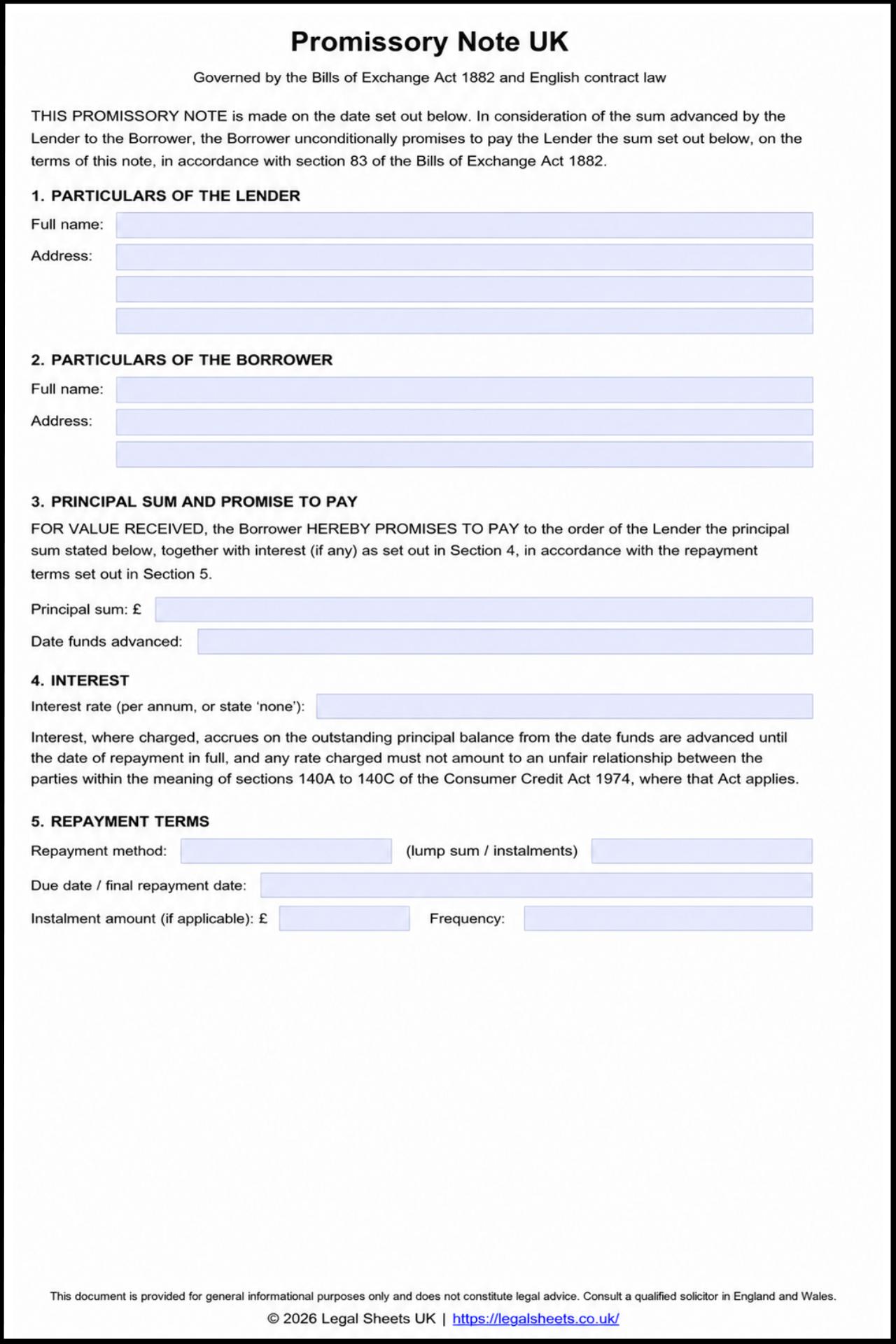
When a Family Loan Agreement Is More Than an Informal Family Arrangement
Family members often arrange loans through conversations. They may agree on the amount and promise to sort out repayment later. That approach can create problems if the relationship changes.
The supplied facts identify the “It Was a Gift” defence as a common enforcement problem. A parent may provide money to a child for a house deposit, for example. The child may later say that the money was a gift and did not need repayment. A signed loan agreement can provide evidence of the parties’ original intention.
The agreement should clearly describe the money as a loan. It should also state that the borrower must repay it under the agreed terms.
Make the Intention to Create Legal Relations Clear
Family arrangements can raise a question about whether the parties intended to create a legally binding agreement. The supplied facts refer to Balfour v Balfour [1919] and Jones v Padavatton [1969] in this context.
A Family Loan Agreement should therefore state that both parties intend to create a legally binding agreement. It should also state that the agreement is enforceable according to its terms.
This wording can help separate the arrangement from an informal family promise. The document should make the lender’s and borrower’s responsibilities clear from the beginning.
State Clearly That the Money Is a Loan, Not a Gift
The agreement should identify the amount being lent and state that the borrower must repay it.
The supplied facts identify the equitable presumption of advancement as a concern where a parent transfers money to a child. They state that the transfer can be presumed to be a gift unless the agreement clearly establishes that the money is a loan.
This is one reason the wording matters so much in family lending. The agreement should not use “gift” language when the parties intend repayment.
The same description should appear throughout the document. Calling the money a loan in one clause and a gift in another can create unnecessary uncertainty.
Set Out the Repayment Date or Repayment Method
The repayment clause should be one of the clearest parts of the agreement.
For a simple contract, section 5 of the Limitation Act 1980 generally provides a six-year period for bringing an action from the date the cause of action accrued.
The agreement should therefore state whether repayment will happen on a fixed date, by instalments, or under another clearly defined arrangement.
A vague promise such as “repay when possible” can create uncertainty. A written repayment schedule gives both parties a much clearer record.
Be Careful With an “On Demand” Loan
Loans without a fixed repayment date can fall within the special rule in section 6 of the Limitation Act 1980. The section covers certain loans that do not provide for repayment on a fixed or determinable date. Where the section applies, a written demand can cause the ordinary six-year period under section 5 to run from the date of that demand.
This means the wording of an “on demand” loan matters. The agreement should clearly explain whether written demand is required before the borrower must repay.
Do not assume that every loan described as “payable on demand” works in exactly the same way. The actual repayment wording can affect when a claim becomes actionable and when limitation begins.
Decide Whether the Loan Is Interest-Free
A family loan can be interest-free if that is what the parties agree.
The agreement should state this clearly if the borrower will repay only the principal. This avoids a later disagreement about whether interest was also due.
If the parties charge interest, the agreement should state the rate and how the interest will apply. The wording should also deal with missed payments where appropriate.
The supplied facts warn against excessive default interest. They give the example of interest increasing from 2% to 25% after a missed payment and refer to the penalty test in Cavendish Square Holding BV v Talal El Makdessi.
A Standard Family Loan Does Not Need Formal Witnessing
The supplied facts state that a standard simple loan agreement does not have a specific statutory requirement for formal execution or witnessing.
The parties can still sign the agreement. Signing provides a clear record that both sides accepted the terms.
The position changes if the parties choose to .execute the agreement as a deed, such as a deed of gift. A deed has separate formal requirements, so the parties should not assume that a simple contract and deed operate in the same way.
If the Loan Is Executed as a Deed
A deed can have a different limitation period. The supplied facts identify a 12-year limitation period for a loan executed as a deed. They also state that the document must say that it is a deed and must be signed in the physical presence of an independent attesting witness.
The relevant legislation identified in the supplied material is the Law of Property (Miscellaneous Provisions) Act 1989, section 1.
The execution requirements matter. The supplied facts state that a defective deed can lose the intended 12-year limitation protection. The document may instead operate as a simple contract with the shorter limitation period.
Do not describe a document as a deed unless the parties intend to use the deed form and follow the required execution process.
Family Loans and Financial Regulation
An ordinary private family loan is not automatically treated in the same way as commercial lending.
The supplied facts state that the relevant exemption applies where the loan is not provided “by way of business.” Informal, non-commercial family lending falls within the stated exemption.
The position can be different where someone regularly lends money in a systematic or business-like way. The supplied facts identify frequent lending, commercial terms and punitive interest as circumstances that may create regulatory concerns.
Calling an arrangement a family loan does not by itself answer every regulatory question. The nature of the lending activity remains important.
Does the Family Loan Agreement Need to Be Registered?
An ordinary private Family Loan Agreement does not need government registration under the supplied facts. The source states that it does not need to be filed, recorded or registered with HMCTS, HMRC or another government regulator.
A different issue arises when the lender wants security over the borrower’s property. The supplied facts state that the loan agreement alone does not create that security. A separate Legal Charge or Mortgage Deed must be executed and registered at HM Land Registry under the Land Registration Act 2002.
A loan agreement and a registered property charge are therefore separate documents and legal steps.
Signing and Exchanging the Agreement
The supplied facts state that the parties can sign the agreement physically or electronically. They also identify electronic signing services such as DocuSign in connection with the Electronic Communications Act 2000.
Both parties should keep a complete signed copy.
The lender should also keep evidence showing that the loan money was actually transferred. The agreement records the terms, while the payment record helps establish that the advance took place.
What Happens If the Borrower Stops Paying?
If the borrower stops making the agreed payments, the lender may need to take court action.
The supplied facts identify the County Court, including Online Civil Money Claims and the CCMCC, as the primary venue for recovering unpaid family loans. They state that claims below £10,000 generally fall within the Small Claims Track, while claims between £10,000 and £100,000 can proceed on the Fast or Intermediate Tracks.
A clear agreement gives the lender evidence of the amount owed and the repayment terms.
The lender must also consider the applicable limitation period. A contractual debt cannot necessarily be enforced indefinitely.
What If the Lender Dies Before Repayment?
A family loan can become part of an estate after the lender dies, making wills and estate planning relevant.
The supplied facts identify the High Court, Chancery Division as a possible forum where an unpaid loan becomes disputed between the lender’s executors and the borrowing family member. One example involves a dispute over whether the outstanding debt should be deducted from the borrower’s inheritance.
The source also states that, unless the Will specifically forgives the loan, the lender’s executors are legally obligated to call in the debt when administering the estate.
This is another reason to keep the signed agreement and payment records safely.
Insolvency Can Leave a Family Lender Unsecured
Many family loans are unsecured.
The supplied facts state that if the borrower becomes bankrupt or enters an Individual Voluntary Arrangement, the family lender generally ranks as an unsecured creditor. The lender may therefore recover only a small proportion of the debt.
A Family Loan Agreement does not automatically give the lender security over property.
If the parties want the loan secured against a house, the supplied facts require a separate Legal Charge or Mortgage Deed and registration at HM Land Registry.
The “It Was a Gift” Dispute
One of the most important practical risks is a later claim that the money was a gift.
The supplied facts give the example of a parent lending money to a child and the child’s spouse for a house deposit. If the relationship later breaks down, the borrower may argue that the money was never intended to be repaid.
A signed Family Loan Agreement can provide evidence of the original intention. It should state the amount advanced, the repayment obligation and the parties’ intention to create legal relations.
Ideally, the agreement should be signed before or when the money changes hands. Waiting until a dispute has already started makes the evidence much harder to manage.
Practical Legal Requirements Table
Yes, you mean only 8–9 rows, not 8–9 columns. Here is the compact version:
| Topic / Issue | England Legal Rule | Governing Law |
|---|---|---|
| Legal Intention | Parties should intend the agreement to be legally binding. | Balfour v Balfour [1919]; Jones v Padavatton [1969] |
| Loan, Not Gift | The agreement should clearly state that the money is repayable. | English Common Law / Equity |
| Repayment & Limitation | Fixed loans generally have a six-year limitation period; certain demand loans have separate rules. | Limitation Act 1980, ss.5–6 |
| Simple Contract & Deed | A simple loan does not require formal witnessing; a deed has separate execution rules and a 12-year period under the supplied facts. | Law of Property (Miscellaneous Provisions) Act 1989, s.1; Limitation Act 1980, s.8 |
| Interest & Default | The agreement should state interest terms; excessive default interest may face a penalty challenge. | Contract Law; Cavendish Square Holding BV v Talal El Makdessi |
| Regulatory Status | The stated family-loan exemption applies where lending is not provided “by way of business.” | Financial Services and Markets Act 2000, s.19 / Consumer Credit Act 1974 |
| Property Security | A separate Legal Charge or Mortgage Deed is required for property security. | Land Registration Act 2002 |
| Electronic Signing | Electronic signing is identified as permissible under the supplied facts. | Electronic Communications Act 2000 |
| Insolvency & Estate | An unsecured family lender generally ranks as an unsecured creditor; the supplied facts state that executors must call in the debt unless the Will forgives it. | Supplied legal facts |
The most important points are the loan-versus-gift distinction and the repayment terms. A family member may remember the arrangement as an informal favour, while the lender expects repayment. The supplied facts specifically identify the “It Was a Gift” argument as a common problem when a parent provides money to a child.
The limitation rules also deserve attention. Section 5 generally gives six years for simple contract claims. Section 6 contains a special rule for certain loans that do not have a fixed or determinable repayment date. A written demand can then cause the ordinary six-year period to run from the date of demand.
The consequence of getting these terms wrong can be serious. The lender may face a limitation defence or difficulty proving that the money was a debt. If the parties intend to use a deed but execute it incorrectly, the intended longer limitation period may also be lost.
Common Family Loan Agreement Mistakes
One common mistake is using the word “gift” when the parties actually intend a loan. The agreement should use consistent language and clearly state that the borrower must repay the money.
Another mistake is failing to state when repayment must happen. The parties should choose a fixed date, instalment schedule, or carefully drafted demand arrangement.
“Repayable on demand” also needs careful drafting. Section 6 of the Limitation Act 1980 contains a specific rule for certain loans without a fixed repayment date. A written demand can affect when the six-year period under section 5 begins.
Excessive default interest is another risk. The supplied facts identify a sharp increase in interest after default as a possible penalty issue under the Makdessi test.
A further mistake is assuming that a signed loan agreement automatically gives the lender a charge over the borrower’s property. It does not do so under the supplied facts. A separate Legal Charge or Mortgage Deed and registration are required when property security is intended.
Family Loan Agreement FAQs
Can a Family Loan Agreement be interest-free?
Yes. The parties can agree that the borrower will repay the principal without interest. The agreement should state this clearly so that neither party later claims that interest was part of the arrangement.
Is a Family Loan Agreement legally binding?
A written agreement can record the parties’ intention to create legal relations. This is particularly useful in family arrangements because the supplied facts identify the presumption that some domestic arrangements were not intended to create legal relations.
How long can a family loan be enforced?
For a simple contract, section 5 of the Limitation Act 1980 generally provides six years from the date the cause of action accrued. Certain loans without a fixed or determinable repayment date fall under the special rule in section 6.
Does a Family Loan Agreement need to be witnessed?
A standard simple loan agreement does not require formal witnessing under the supplied facts. A deed is different and has separate execution requirements, including signing in the physical presence of an independent attesting witness.
Can a family member later claim that the money was a gift?
Yes. The supplied facts identify this as a common dispute when a parent lends money to a child. A signed agreement can provide evidence that the parties intended the money to be repaid.
Does a Family Loan Agreement need to be registered?
No, not as an ordinary private agreement under the supplied facts. The source states that it does not need to be filed or registered with HMCTS, HMRC or another government regulator. Property security involves a separate process.
What happens if the borrower becomes insolvent?
The supplied facts state that an unsecured family lender generally ranks as an unsecured creditor if the borrower becomes bankrupt or enters an Individual Voluntary Arrangement. The lender may recover only a small proportion of the debt.
What happens to the loan if the lender dies?
The supplied facts state that the lender’s executors must call in the outstanding debt unless the Will or Last Will and Testament specifically forgives the loan.. The debt can therefore become part of the estate administration process.