
Purchase Order Template Free PDF
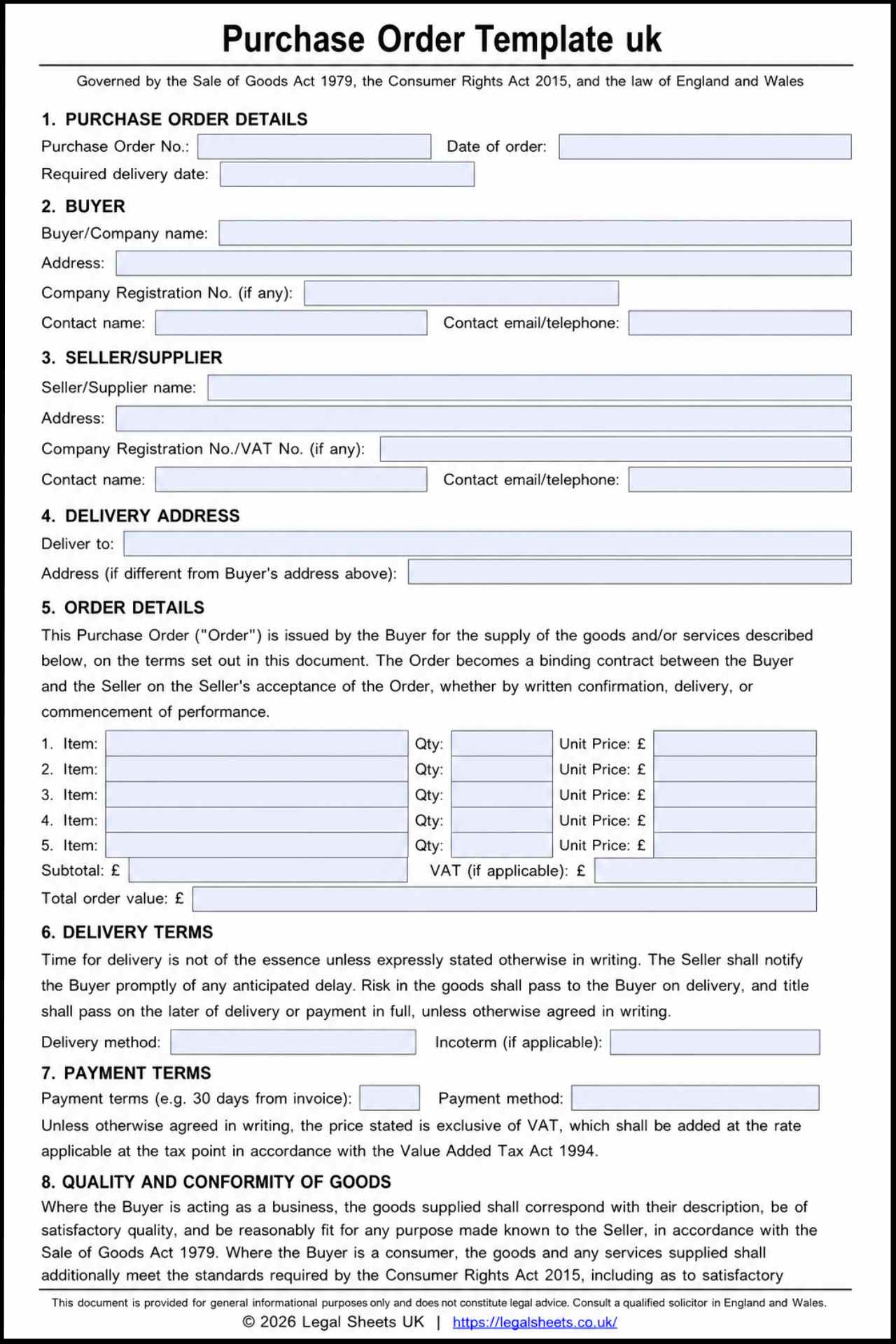
A Purchase Order Template becomes particularly useful when a supplier is ready to start work or dispatch goods but the buyer needs a clear record of exactly what has been ordered and on what terms. The common problem isn’t usually the PO itself; it’s what happens afterwards when the supplier sends an acknowledgement containing different conditions and the buyer carries on without checking them. For relevant business sales, the Sale of Goods Act 1979 can also affect implied terms concerning description, satisfactory quality and fitness for purpose, while liability exclusions may be subject to the Unfair Contract Terms Act 1977.
If a dispute later reaches the County Court, the original PO, supplier response, specifications and acceptance trail can become important evidence of what the parties actually agreed. The template below gives businesses a practical structure for recording the order, commercial details, delivery requirements and purchasing conditions.
Table of Contents
TogglePurchase Order Template (PDF, Word & Printable Formats)
How a Purchase Order Becomes a Contract
A purchase order is often treated internally as a purchasing instruction, but its legal effect depends on what happens between the buyer and supplier. Under the verified England legal framework, a PO generally operates as an offer to purchase, with a binding contract arising through formal acceptance or performance by conduct.
When the PO is only an offer
Sending a purchase order does not automatically mean that the supplier has accepted every term printed on it. The buyer may issue the PO as an offer containing the proposed price, specifications, delivery arrangements and purchasing conditions.
The supplier can then expressly accept the order, or its conduct may amount to acceptance. Starting work, manufacturing goods or otherwise performing the order can become relevant when determining whether a contract was formed.
This distinction matters when a buyer tries to cancel an order before delivery. If the supplier has already taken steps that amount to acceptance by conduct, the buyer may no longer be dealing with an unaccepted offer.
The battle of the forms
The difficult situation usually starts when the buyer and supplier each have their own standard terms.
For example, a buyer may issue a PO stating that its purchasing conditions apply, while the supplier sends an order acknowledgement containing different delivery, liability and payment terms. If the buyer then accepts delivery without addressing the supplier’s terms, the parties can face a dispute over which conditions govern the transaction.
Under the English common-law ‘last-shot doctrine’ (Tekdata Interconnections Ltd v Amphenol Ltd [2009]), if a supplier issues an order acknowledgement containing counter-terms and the buyer accepts delivery without objection, the supplier’s terms govern, completely defeating the buyer’s purchase order conditions.
Getting the acceptance trail right
A sensible purchasing process should preserve the sequence of events rather than only the final invoice. Keep the original PO, the time it was issued, any supplier acknowledgement, relevant emails and procurement-portal records.
The audit trail can become particularly important where the supplier begins manufacturing without signing the PO. If the buyer later attempts to cancel, the evidence may be needed to establish whether the supplier accepted the offer by conduct.
The Information That Should Appear on the Purchase Order
A useful PO needs enough information for someone outside the original purchasing conversation to understand exactly what was ordered.
Buyer and supplier identification
Under Section 82 of the Companies Act 2006 and Regulation 24 of the Company, Limited Liability Partnership and Business (Names and Trading Disclosures) Regulations 2015, corporate purchase orders must explicitly display the company’s full registered name, registered office address, company number, and jurisdiction of registration
These details should not be treated as decorative information. A PO issued under an incorrect trading identity can create unnecessary uncertainty about who actually entered the transaction.
The purchase order should also identify the supplier clearly, particularly where the supplier trades under a different business name from its registered company.
Purchase and delivery details
The order should identify the PO number, order date, required delivery date and delivery address. Each item should be described with enough detail to distinguish it from similar products.
Quantities, specifications, unit prices, VAT and the total order value should also be recorded.
A vague line such as “100 units of standard equipment” may create problems later if the parties disagree about the required specification. Product descriptions should be sufficiently detailed for the buyer to compare what was ordered against what was eventually supplied.
Approval and authority
The person placing the order should have the authority required by the buyer’s internal purchasing process.
Larger businesses often have approval thresholds, meaning a member of staff may be able to order routine supplies but need additional approval for a high-value purchase. Keeping that approval record with the PO can become useful if the transaction is later challenged internally or commercially.
Writing Product Specifications That Protect the Buyer
A purchase order becomes much harder to enforce when the goods are described too loosely. The specification should reflect what the buyer actually needs, not merely what was discussed informally with the supplier.
Avoiding vague descriptions
Product codes can be useful, but they may not always provide enough information on their own. Depending on the purchase, the PO may need dimensions, tolerances, quality requirements, packaging requirements or applicable standards.
Consider a buyer ordering manufactured components. If the PO contains only a supplier product code but no relevant dimensions or tolerances, proving that the delivered goods failed to meet the agreed specification can become much more difficult.
Connecting specifications to statutory rights
Under Sections 13, 14, and 15 of the Sale of Goods Act 1979, B2B sales contracts carry statutory implied terms that goods will correspond with their description, be of satisfactory quality, and be reasonably fit for any expressly made-known purpose.
The PO should therefore support those statutory protections rather than undermine them through vague drafting.
Where a particular purpose has been discussed with the supplier, recording the relevant requirement clearly can also create useful evidence about what the supplier was expected to provide.
Changes to specifications
Changes should be recorded rather than left to telephone conversations.
A revised specification should identify the change, confirm the supplier’s acceptance and record any resulting effect on price or delivery. Keeping the amendment with the original PO creates a much clearer audit trail if the final invoice differs from the original order.
Delivery, Ownership and Risk
Delivery is often where an apparently straightforward purchase becomes a commercial dispute. The PO should make the delivery obligation clear enough that both sides understand when and where performance is expected.
Setting the delivery obligation
Record the required delivery date, delivery location and any agreed requirements concerning partial deliveries or inspection.
Where transportation forms part of the arrangement, the PO should also identify who is responsible for the relevant transport arrangements.
A buyer receiving only part of an order may have a different commercial problem from a buyer receiving the wrong goods altogether. Clear delivery terms give the purchasing team something concrete against which performance can be checked.
Separating ownership from risk
Ownership and risk are separate issues and should not be treated as interchangeable.
The verified framework identifies sections 17 and 18 of the Sale of Goods Act 1979 in relation to when property passes, while section 20 addresses default rules concerning risk. A PO should therefore make the intended allocation clear where the transaction creates meaningful exposure for the buyer.
This becomes especially important for goods travelling over significant distances or involving expensive freight.
What happens when goods are damaged in transit?
The buyer should know what evidence to retain when goods arrive damaged. Delivery records, inspection notes and photographs can become important evidence.
The contractual allocation of risk should also be checked before the buyer assumes that the supplier automatically carries responsibility for damage occurring before the goods reach the buyer.
Payment, Invoices and Late Commercial Debts
Payment provisions should match the purchasing process. A PO that states a price but says little about invoicing can leave the accounts team dealing with avoidable disputes.
Setting clear payment terms
The PO should identify the payment deadline, accepted payment method and VAT treatment where relevant. Requiring the supplier to quote the PO number on its invoice can also make invoice matching much easier.
For larger purchasing systems, this information can be particularly useful because an invoice may pass through several internal checks before payment.
Late payment consequences
The verified framework identifies the Late Payment of Commercial Debts (Interest) Act 1998 as relevant to qualifying commercial debts.
The statutory regime can provide interest, fixed compensation and recovery costs when qualifying commercial balances remain overdue. The PO should therefore not be drafted as though payment disputes have no financial consequences after the contractual deadline passes.
Withholding payment over defective goods
A buyer should not simply stop paying an invoice because the goods appear defective without checking the contractual position.
The relevant issues may include rejection, set-off and any contractual notice requirements. A purchasing team that withholds payment informally may create a second dispute alongside the original quality complaint.
Buyer Terms and Conditions: The Clause That Often Gets Missed
One of the most consequential parts of a purchase order can be the wording that identifies the buyer’s standard purchasing terms.
Incorporating standard purchase terms
If the buyer wants its standard terms to apply, those terms should be clearly identified and properly attached or referenced.
The supplier should have reasonable notice of the terms before acceptance. Particular attention is needed where the conditions contain unusual or onerous provisions
What happens when the supplier sends its own terms?
A supplier’s order acknowledgement may contain conditions that differ significantly from the buyer’s PO.
The same problem can arise through a delivery note or supplier quotation. If the buyer accepts the goods without addressing the conflicting terms, the parties may later argue about which document contains the operative conditions.
This is the classic battle-of-the-forms problem. It should be dealt with when the order is placed, not after the goods have already been delivered.
Website terms and hyperlinks
Simply placing a generic website address on a PO does not necessarily solve the incorporation problem.
The supplier should have clear notice of the relevant terms and access to them before acceptance. The risk becomes greater where the online terms contain unusual provisions such as substantial liquidated damages or broad indemnities.
The verified framework identifies Interfoto v Stiletto as relevant to the treatment of onerous or unusual terms.
Liability, Indemnities and Limitation Clauses
Commercial buyers sometimes try to deal with risk through extensive exclusion clauses. Those provisions need to be drafted with care.
Limiting liability in a commercial PO
The Unfair Contract Terms Act 1977 imposes statutory controls on certain exclusions and limitations.
Under the verified facts, terms attempting to exclude or limit liability for death or personal injury caused by negligence cannot simply be relied upon, while other relevant exclusions may need to satisfy the statutory reasonableness test.
A broad clause saying that the supplier accepts no responsibility for any loss should therefore not be treated as automatically effective.
Indemnities and supplier responsibility
Depending on the transaction, the buyer may need contractual protection concerning product defects, third-party claims, intellectual-property infringement or losses caused by negligent performance.
The wording should reflect the actual commercial risk. A small routine purchase does not necessarily need the same liability structure as a major supply-chain transaction.
Clauses that cannot simply be excluded
The verified framework specifically identifies restrictions concerning death or personal injury caused by negligence and statutory implied terms.
Where an exclusion or limitation is subject to the statutory reasonableness test, simply including it in the PO does not guarantee enforcement.
Late Delivery and Contractual Deductions
Late delivery can have serious commercial consequences, particularly where the buyer’s own production or customer commitments depend on the supplier.
Setting realistic delivery remedies
A contractual remedy for delay should reflect the buyer’s legitimate commercial interest rather than operate as a punishment.
The parties should consider what financial consequence would reasonably correspond to the disruption caused by late performance.
Avoiding unlawful penalty clauses
A clause requiring a supplier to lose 10% of the entire PO value for every day of delay may appear attractive to a buyer, but excessive deductions can create enforceability problems.
The verified legal facts identify Cavendish Square Holding BV v Talal El Makdessi and the relevant penalty test. The safer drafting approach is to create a commercially defensible remedy that reflects the legitimate interest being protected.
Purchase Orders Involving Services
Not every PO concerns physical products. Some cover consultancy, installation, maintenance or other services.
When the order covers services
A services-based PO should describe the scope, expected performance standard, timetable and acceptance criteria.
The verified framework identifies the Supply of Goods and Services Act 1982 as relevant where the PO includes services, including duties concerning reasonable care and skill and reasonable time where applicable.
For a service such as equipment installation, the buyer should avoid relying only on the phrase “installation included”. The PO should identify what installation involves and when the work is considered complete.
Mixed goods-and-services orders
Mixed transactions can create uncertainty when the supply of goods and the provision of services are combined.
The PO should distinguish the product obligation from the service obligation where practical. This can help identify which requirements apply to the goods and which relate to installation, maintenance or other services.
Electronic Purchase Orders and Record Keeping
Electronic purchasing is now routine, but the evidence should still be retained carefully.
Can a purchase order be electronic?
Yes. The verified framework recognises electronic transmission and electronic signatures under hand, including electronic communications within the scope of section 7 of the Electronic Communications Act 2000.
A business may issue a PO through an ERP system, procurement portal or PDF email attachment.
What records should the buyer retain?
The purchasing file should contain the original PO and any standard terms supplied with it. It should also retain the supplier acknowledgement, relevant emails, portal records, amendments, delivery records and invoices.
Keeping only the final invoice can make it much harder to reconstruct what was actually agreed.
Why the audit trail matters
The audit trail should allow the business to establish when the offer was made, how the supplier responded and which terms were available before performance began.
That evidence can become decisive when the parties disagree about contract formation or the applicable terms.
Common Purchase Order Mistakes That Create Disputes
Issuing the PO without the buyer’s terms
If the buyer intends to rely on standard purchasing conditions but does not properly incorporate them, the supplier’s terms may become central to the dispute.
The problem is not simply that the buyer loses a preferred clause. Liability, payment, delivery and dispute provisions may all be affected.
Using vague product descriptions
A vague specification can make a quality dispute much harder to prove. Product codes, broad descriptions and missing technical tolerances can leave the buyer struggling to demonstrate exactly what was required.
That is particularly relevant to claims relying on the statutory protections concerning sale by description and satisfactory quality.
Ignoring supplier counter-terms
A supplier acknowledgement should not be treated as an administrative document without checking its conditions.
If the acknowledgement introduces materially different terms and the buyer proceeds without objection, the resulting contract may not operate on the buyer’s original terms.
Failing to clarify risk
Where the PO does not adequately address ownership and risk, a dispute can arise when goods are lost or damaged during transportation.
The buyer may discover the problem only after the shipment has already been damaged, when changing the commercial position is no longer straightforward.
Adding excessive late-delivery deductions
A large deduction for every day of delay may look like strong buyer protection, but a disproportionate clause can be challenged as a penalty.
The commercial remedy should therefore be connected to the legitimate interest the buyer is trying to protect.
Failing to keep the acceptance record
A missing acknowledgement or incomplete purchasing record can create uncertainty about when the contract was formed and which terms were incorporated.
For significant purchases, preserving the complete transaction history is far more useful than keeping the PO alone.
Purchase Order Legal Requirements in England
Legal Requirements Table
| Topic / Issue | Precise Legal Rule | Governing Statute / Common Law Precedent |
|---|---|---|
| Corporate PO Disclosures | Commercial purchase orders must legibly display registered company name, registered office address, number, and UK jurisdiction. | Companies Act 2006 (Section 82) / SI 2015/17 |
| Statutory Sale of Goods | B2B supply of goods contracts imply statutory terms that goods match description, satisfactory quality, and fitness for purpose. | Sale of Goods Act 1979 (Sections 13, 14, & 15) |
| Supply of Services Terms | Purchase orders covering services imply statutory duties of reasonable care and skill and performance within a reasonable time. | Supply of Goods and Services Act 1982 (Sections 12 & 13) |
| Late B2B Commercial Debt | Overdue commercial invoices automatically accrue statutory interest at 8% above base rate plus fixed administrative compensation. | Late Payment of Commercial Debts (Interest) Act 1998 (Sections 5 & 5A) |
| Negligence Exclusions | Exclusions or restrictions of liability for death or personal injury caused by negligence are absolute blacklisted and void. | Unfair Contract Terms Act 1977 (Section 2(1)) |
| B2B Standard Terms Reasonableness | Limitation clauses in standard commercial terms are void unless they satisfy the statutory test of commercial reasonableness. | Unfair Contract Terms Act 1977 (Sections 3 & 11) |
| Penalty Clauses | Contractual late delivery deductions are unenforceable penalties unless proportionate to a legitimate commercial interest. | English Common Law / Cavendish Square v Makdessi [2015] |
| Electronic Communications | Electronic purchase order transmission and electronic signatures hold full legal validity in contract formation. | Electronic Communications Act 2000 (Section 7) |
Practical Legal Impact
The legal rules above affect different parts of the purchasing process rather than operating as one single set of requirements. Corporate identity information belongs on the commercial document, while the Sale of Goods Act 1979 can affect the quality and description of goods being ordered.
The greatest operational risk often arises from the relationship between the PO and the supplier’s documents. A buyer may believe its terms apply because they are printed on the PO, only to discover later that the supplier’s acknowledgement or conduct created a different contractual position.
Liability clauses require similar care. The presence of a limitation clause does not remove the statutory reasonableness requirements identified under the Unfair Contract Terms Act 1977.
Where Purchase Order Disputes Are Likely to End Up
Commercial PO disputes can move beyond the purchasing department when the parties cannot resolve payment, quality, delivery or contractual interpretation issues.
County Court claims
Lower-value B2B debt, quality and delivery disputes may be dealt with through the County Court, including the Small Claims Track for claims within the stated threshold.
The evidence will usually begin with the transaction itself: the PO, supplier response, delivery documents and invoice.
High Court commercial disputes
Higher-value supply-chain disputes may reach the High Court, including the King’s Bench Division, Commercial Court or Technology and Construction Court where the nature of the dispute falls within their jurisdiction.
Major procurement disputes can involve detailed questions about contract formation, competing standard terms, specifications and supply-chain obligations.
What evidence usually matters
A business facing a PO dispute should be able to produce the original purchase order, supplier quotation, acceptance or acknowledgement and the relevant standard terms.
Technical specifications, delivery records, invoices, correspondence and inspection evidence can also become important.
In practice, the strongest evidence is often the chronological record showing what each side knew and accepted before performance began.
When a Purchase Order Is Not Enough on Its Own
A PO works well for defined purchasing transactions, but it may not be sufficient where the commercial relationship is more complicated.
Larger or repeat supply arrangements
Businesses with recurring orders may need a framework or master supply arrangement covering the wider relationship.
This can address matters that would be impractical to repeat on every individual PO, such as pricing structures, recurring obligations and broader contractual conditions.
High-risk purchases
Bespoke manufacturing, major equipment, software, critical components and installation projects can create risks that exceed what a simple PO can comfortably address.
A more detailed agreement may be appropriate where performance, acceptance, intellectual property or liability requires extensive drafting.
Where detailed contractual protection is needed
A separate service agreement may be preferable where the transaction requires extended warranties, detailed liability allocation, confidentiality, intellectual-property provisions, insurance requirements, service levels, termination rights or a detailed dispute procedure.
The PO can then operate within that wider contractual structure rather than carrying every obligation by itself.
Frequently Asked Questions
Does a purchase order create a contract in England?
A purchase order generally operates as an offer to buy. A binding contract can arise through formal acceptance or performance by conduct. The precise position depends on what the supplier does after receiving the PO and what terms the parties have exchanged.
Can a supplier’s terms override a buyer’s purchase order?
They can become highly significant where the supplier responds with different terms and the buyer proceeds without resolving the conflict. The verified framework identifies the battle-of-the-forms issue and the possibility of acceptance by conduct. Buyers should therefore check supplier acknowledgements rather than treating them as routine paperwork.
Do purchase orders need to be signed?
A purchase order does not normally require deed-style witnessing or execution formalities. The verified framework recognises electronic transmission and electronic signatures under hand. Even so, businesses should retain evidence showing who issued the PO and how the supplier accepted or performed it.
What happens if the purchase order has the wrong company details?
Corporate purchase orders must contain the relevant registered company information under the verified framework. Missing or incorrect details can create compliance consequences and uncertainty about the contracting entity. The purchasing document should use the company’s registered legal identity rather than relying only on a trading name.
Can a buyer charge a supplier for late delivery?
A buyer can include contractual remedies for late delivery, but the remedy should be commercially defensible. Excessive deductions can create penalty-clause problems. The verified framework identifies the proportionality approach associated with Cavendish Square Holding BV v Talal El Makdessi.
Can a purchase order include terms and conditions by reference?
Yes, but the terms need to be properly identified and made available before acceptance. This becomes particularly important where the conditions contain unusual or onerous provisions. A vague reference to terms on a website may not be sufficient in every circumstance.
Who bears the risk if goods are damaged before delivery?
The answer depends on the contractual allocation of risk and the applicable statutory rules. The verified framework identifies sections 17, 18 and 20 of the Sale of Goods Act 1979 as relevant to property and risk. A PO should therefore address delivery and risk clearly where damaged goods could create significant financial exposure.
Can a buyer refuse to pay for defective goods?
That depends on the contract and the buyer’s statutory rights. The buyer should check the applicable rejection, set-off and notification provisions before withholding payment. Simply refusing an invoice without following the relevant contractual procedure can turn a quality dispute into a separate payment dispute.
Author
-

Ankur is the founder and editorial reviewer at LegalSheets. He researches, writes, and reviews legal content, ensuring every template and guide is clear, accurate, and based on current UK laws and official government guidance. His focus is on making legal documents easier for individuals and businesses to understand and use.
