
Cease and Desist Letter Free Fillable PDF & Word
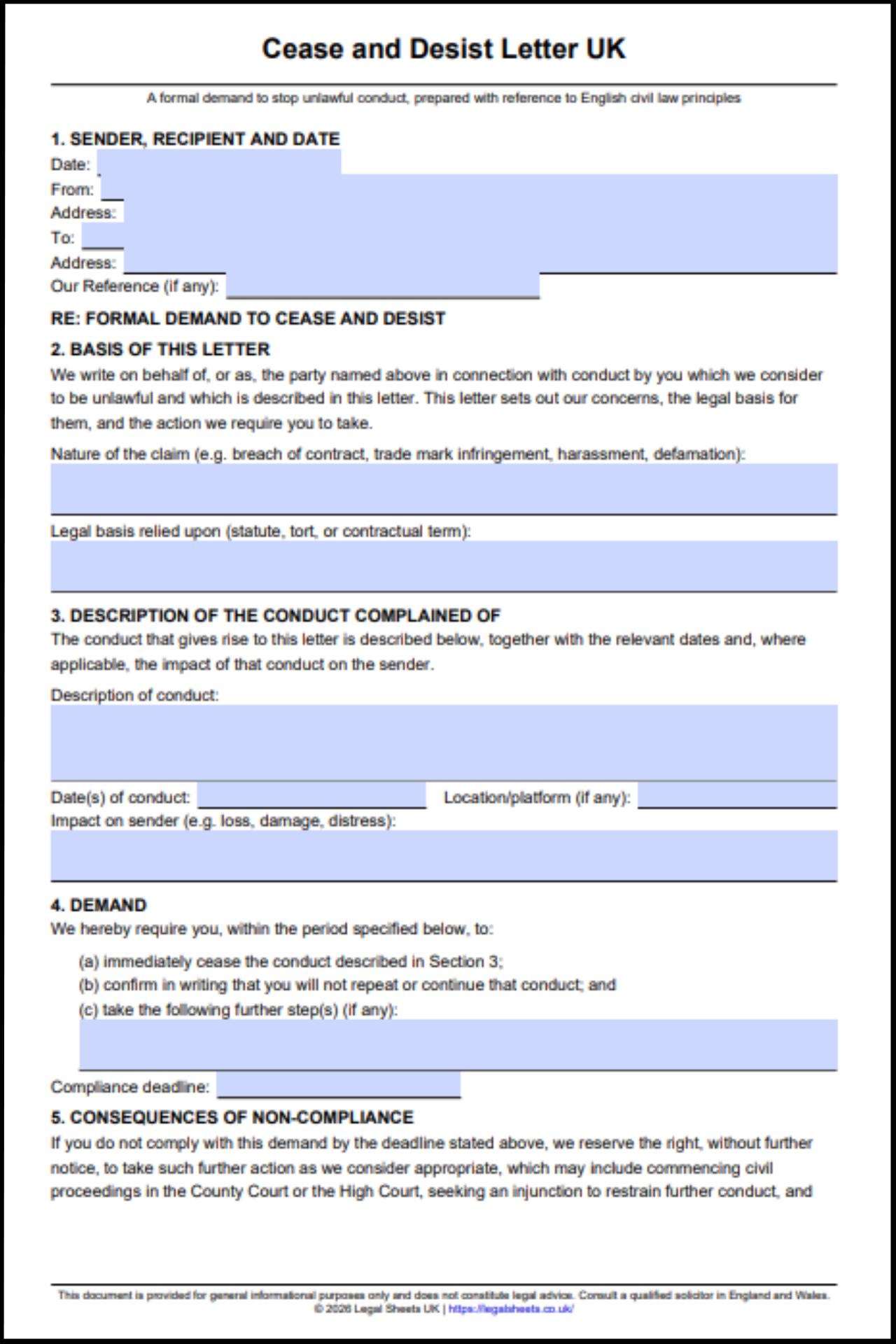
A Cease and Desist Letter is often used when an individual or business needs another party to stop conduct that may be causing legal or commercial harm, particularly where the dispute concerns intellectual property, defamation, harassment or a contractual obligation. The difficult part is not simply demanding that the conduct stops; the allegations, requested action and any reference to future proceedings need to correspond with the rights actually involved.
This is particularly important in intellectual property disputes because unjustified threats concerning certain rights can create their own legal consequences. A properly prepared letter can therefore give the recipient a clear opportunity to address the alleged conduct before the matter progresses towards court proceedings, which GOV.UK recognises as one possible route for resolving IP disputes.
Table of Contents
ToggleCease and Desist Letter Template (PDF, Word, Fillable & Editable Formats)
When a Cease and Desist Letter Should Be Used
The starting point is the conduct that needs to stop. A useful letter should make that conduct sufficiently clear that the recipient can understand what is being challenged and what action is being requested.
A written demand can also establish that the recipient was placed on notice of the complaint. That can become important if the dispute later develops into court proceedings.
Under the Civil Procedure Rules 1998 (CPR), a formal Letter of Claim must adhere strictly to the Practice Direction on Pre-Action Conduct and Protocols. The sender must clearly detail the legal basis of the claim, provide a factual summary, disclose core documentation, and propose a sensible timetable for engagement.
If the underlying dispute requires urgent court intervention, relying on correspondence alone may also be inappropriate. A cease and desist letter does not itself compel compliance.
Drafting the Legal Basis Without Overstating the Claim
A common drafting problem is making the letter sound more legally certain than the available evidence permits. The allegation should be tied to the actual conduct and the legal right said to have been infringed.
Identify the Exact Conduct
State what the recipient allegedly did rather than relying on broad accusations.
Where relevant, identify:
- dates;
- publications;
- transactions;
- communications;
- products or services;
- contractual provisions; or
- other information that allows the recipient to identify the disputed conduct.
For example, alleging that someone has acted unlawfully without explaining what they actually did gives the recipient little practical information about what needs to stop.
The letter should also avoid allegations that cannot reasonably be supported. Unsupported accusations can create additional legal problems, particularly if they are communicated to people other than the recipient.
Match the Allegation to the Legal Right
The legal basis should correspond with the actual dispute. Potential matters covered by the supplied framework include:
- contractual breach;
- copyright or other intellectual property infringement;
- harassment;
- defamation;
- trespass;
- nuisance; and
- passing off.
The governing legal framework depends on the nature of the complaint. The supplied legal framework identifies common law and the law of tort for matters such as breach of contract, private nuisance, trespass and passing off, while specific statutory regimes apply to areas such as intellectual property, harassment and defamation.
State the Action Required
The recipient should be able to identify what the sender wants them to do.
Depending on the dispute, this might involve:
- stopping the complained-of conduct;
- removing or amending material;
- delivering up relevant material where legally justified; or
- addressing an additional remedy sought by the sender.
Where a monetary remedy is sought alongside a demand to stop conduct, the basis for that demand should be stated clearly rather than presented as an unexplained figure.
Turning the Letter Into Effective Pre-Action Correspondence
Once a cease and desist letter is being used as correspondence before potential litigation, its role becomes more procedural. The letter should give the recipient enough information to understand the claim and respond meaningfully.
Information to Include Before Court Proceedings
The supplied framework identifies several important elements where the correspondence is intended to precede court proceedings:
- a concise basis of the claim;
- relevant facts;
- the remedy sought;
- key supporting documents; and
- appropriate response arrangements.
The framework specifically states that the basis of the claim should explain what the recipient has allegedly done wrong, while the remedy should identify what the sender wants the recipient to do. Relevant key documents should also be listed or enclosed.
This is more useful than sending a highly aggressive letter containing little factual information. If the recipient cannot understand the allegation, the correspondence may fail to achieve the practical purpose for which it was sent.
Choosing a Reasonable Response Period
Avoid automatically demanding compliance within 24 or 48 hours.
Under paragraph 6 of the CPR Practice Direction on Pre-Action Conduct, the sender must allow a reasonable response window—typically 14 days for straightforward claims and up to 3 months for complex commercial disputes. Demanding compliance within 24 to 48 hours is considered aggressive litigation conduct and triggers adverse costs sanctions from English judges.
The appropriate period therefore depends on the circumstances. A complicated dispute involving documents, multiple allegations or substantial commercial issues may require more time than a straightforward matter.
An unnecessarily short deadline can also create costs consequences if the correspondence is later considered by the court.
Considering Alternative Dispute Resolution
Not every dispute needs to progress immediately to litigation.
Where negotiation or another form of Alternative Dispute Resolution could realistically resolve the disagreement, the correspondence can identify that possibility. The supplied framework specifically recommends reminding parties of the court’s expectation that ADR be considered before proceedings are issued.
That does not mean the sender must abandon a legitimate claim. It means the letter should avoid escalating the dispute unnecessarily where a practical resolution remains possible.
Intellectual Property Threats: The Risk of Getting the Letter Wrong
Intellectual property demands require particular care because the law places restrictions on certain threats of infringement proceedings.
Patent, Trade Mark and Design Infringement Allegations
Under the Intellectual Property (Unjustified Threats) Act 2017, making groundless threats of infringement proceedings concerning patents, registered trade marks, or design rights against ‘secondary actors’ (such as retailers, distributors, or importers) gives the recipient an immediate statutory right to sue the sender for damages and injunctive relief.
A particularly important risk arises where the recipient is a secondary actor, such as a retailer or distributor, rather than the party alleged to have manufactured the infringing product.
Before sending an infringement demand, the sender should therefore identify precisely:
- which intellectual property right is relied upon;
- what conduct is alleged to infringe it; and
- who is actually responsible for that conduct.
Avoiding an Unjustified Threat
The problem is not simply whether the sender believes an infringement has occurred. The wording and target of the threat also matter.
The supplied framework identifies the possibility of the recipient bringing an action for an unjustified threat, potentially seeking an injunction against further threats and damages for commercial losses.
That makes exaggerated intellectual property wording particularly risky. A demand should be based on the actual right and conduct being relied upon rather than using generic infringement language.
Service, Evidence and Keeping a Proper Record
A cease and desist letter is only useful if the sender can demonstrate what was sent and, where relevant, that it reached the intended recipient.
Sending the Letter
The supplied framework identifies the following practical methods:
- First Class post;
- courier; and
- email where appropriate.
The sender should select a method capable of establishing delivery.
Where the recipient later disputes having received the demand, evidence of delivery can become important.
Preserving Evidence
Keep the exact version of the letter that was sent. Do not rely solely on a later copy that has been edited.
The sender should retain:
- the final letter;
- delivery or receipt evidence;
- supporting documents;
- relevant communications; and
- evidence underlying the allegations.
The supplied framework specifically identifies recorded delivery receipts, courier signatures and email read receipts as examples of evidence that may help demonstrate delivery.
Open and Without Prejudice Correspondence
A letter intended to establish that a warning was given will generally need to remain available as evidence of that communication.
A Cease and Desist letter must generally be sent as an ‘Open’ communication. Marking a demand ‘Without Prejudice’ is a fatal tactical error because the sender will be legally barred from presenting the letter to a judge to prove formal pre-action notice was given or to seek legal costs.
Open correspondence and genuine settlement communications should therefore not be treated as interchangeable.
Cease and Desist Letters That Can Create Additional Legal Problems
A demand intended to stop unlawful conduct can itself create legal exposure if it crosses the line into improper threats or unnecessary publication.
Threats That Cross Into Blackmail
A demand for money should not be accompanied by threats of criminal prosecution or exposure of private information merely to pressure the recipient into payment.
The supplied framework identifies section 21 of the Theft Act 1968 in connection with blackmail.
The practical point is straightforward: a demand should identify legitimate legal remedies rather than use unlawful pressure to obtain compliance.
Repeated Communications and Harassment
Sending repeated, baseless or intimidating correspondence can create a separate problem.
The supplied framework identifies the Protection from Harassment Act 1997 and states that harassment involves a course of conduct occurring on at least two occasions and causing alarm or distress.
A sender should therefore avoid turning a legitimate demand into a campaign of repeated communications.
Allegations Sent to Third Parties
A cease and desist letter should not normally be circulated unnecessarily to people who have no legitimate reason to receive it.
For example, copying an employer, customer or member of the press into allegations of fraud or misconduct can create additional defamation risks. The supplied framework identifies the Defamation Act 2013 and common law defamation in this context.
Keeping the communication directed to the person responsible for the alleged conduct can therefore be an important practical safeguard.
What Happens If the Recipient Ignores the Letter?
A cease and desist letter does not guarantee compliance. If the recipient ignores it, the sender has to decide whether pursuing the underlying claim is justified.
Deciding Whether to Issue Proceedings
Before proceedings are started, assess:
- whether the underlying claim is sufficiently supported;
- whether an applicable pre-action protocol must be followed;
- what evidence is available; and
- what remedy is actually being sought.
A poorly prepared demand followed by immediate proceedings can create avoidable procedural and costs problems. The supplied framework specifically identifies the possibility of costs sanctions where pre-action correspondence fails to comply with the applicable standards.
Applying for Urgent Court Relief
Where simply asking the recipient to stop is insufficient, an interim injunction may become relevant.
The supplied framework identifies CPR Part 25 in connection with interim injunctions. It also stresses that the cease and desist letter itself is not a court order and has no independent coercive legal power.
This distinction matters. Sending the letter does not give the sender the power to physically compel the recipient to comply.
Cross-Undertaking in Damages
Seeking an interim injunction can carry significant financial risk.
The supplied framework identifies a cross-undertaking in damages as a binding promise associated with an interim injunction application. If the injunction is later found to have been wrongly granted, the undertaking can expose the applicant to financial losses suffered by the defendant as a result.
This is one reason why a cease and desist letter should not be drafted as though court proceedings are merely an empty threat.
UK Legal Facts: Cease and Desist Letter Requirements
Legal Requirements Table
| Topic / Issue | Precise Legal Rule | Governing Statute / Statutory Precedent |
| Pre-Action Protocol Obligations | Formal demand letters preceding litigation must specify the legal basis, summary of facts, remedies sought, and key documents. | CPR Practice Direction – Pre-Action Conduct & Protocols (Para 6) |
| Reasonable Response Window | Senders must provide a realistic deadline (typically 14 days for simple claims, up to 3 months for complex disputes) before issuing proceedings. | CPR Practice Direction – Pre-Action Conduct (Para 6) |
| Unjustified IP Threats | Groundless infringement threats regarding patents, trade marks, or design rights against secondary parties create civil liability. | Intellectual Property (Unjustified Threats) Act 2017 |
| Harassment Threshold | Course of conduct involving repeated, oppressive, or unjustified demands on at least two occasions is actionable in civil and criminal law. | Protection from Harassment Act 1997 (Sections 1 & 7) |
| Blackmail Prohibition | Unwarranted demands for money accompanied by menaces of criminal reporting or exposure constitute an offence. | Theft Act 1968 (Section 21) |
| Third-Party Defamation | Copying unproven allegations to third parties forfeits privilege and creates exposure to actionable libel claims. | Defamation Act 2013 (Section 1) / Common Law |
| Interim Injunctions | Urgent relief to restrain unlawful conduct is secured via High Court applications satisfying the American Cyanamid balance test. | Civil Procedure Rules (CPR Part 25) / American Cyanamid [1975] |
| Cross-Undertaking in Damages | Claimants seeking interim relief must give a binding undertaking to compensate the defendant if the injunction is discharged at trial. | CPR Part 25 / Senior Courts Act 1 |
The supplied framework identifies these requirements as the principal operational issues affecting preparation, service and later reliance upon the correspondence.
Practical Legal Impact
There is no single statutory form for a cease and desist letter. Where it is simply a private demand, there are no general filing or registration formalities.
The position changes in practical terms when the correspondence is intended to precede litigation. The sender should then provide enough information for the recipient to understand the claim and respond, while avoiding unnecessary threats or unrealistic deadlines.
The distinction is important because a letter can be perfectly usable as private correspondence without necessarily satisfying every requirement that may apply to formal pre-action conduct.
Common Cease and Desist Letter Mistakes
Making Unsupported Legal Threats
A letter becomes less effective when it makes sweeping allegations that cannot be substantiated.
There is also a greater risk where the threat falls within a specific statutory regime, such as the restrictions on unjustified intellectual property threats.
Giving an Unrealistic Deadline
A demand that requires payment or compliance within 24 or 48 hours may look forceful, but the supplied framework identifies this as a potential pre-action problem where the circumstances do not justify such urgency.
A reasonable response period is generally safer where litigation is contemplated.
Failing to Identify the Actual Wrongdoing
The recipient needs to know what conduct is being challenged.
A vague statement that the recipient is acting unlawfully does not identify the relevant conduct, legal right or remedy. The supplied framework therefore emphasises the basis of the claim and the facts supporting it.
Copying Unproven Allegations to Third Parties
Unnecessary circulation can transform a private dispute into a separate defamation problem.
The safer practical approach is to keep allegations directed to the relevant recipient unless there is a legitimate reason for communicating them elsewhere.
Treating the Letter as a Court Order
This is one of the most basic misunderstandings.
A cease and desist letter is a private demand. It does not itself compel the recipient to comply. If the recipient refuses, the sender must consider the appropriate legal route for enforcing the underlying right.
Where Disputes May Be Taken After a Cease and Desist Letter
High Court and Intellectual Property Enterprise Court
The supplied framework identifies the High Court, including the Chancery Division and Intellectual Property Enterprise Court (IPEC) for disputes involving matters such as intellectual property, breach of confidence and complex corporate disputes.
King’s Bench Division
The supplied framework identifies the High Court (King’s Bench Division) for matters including defamation, privacy breaches and higher-level harassment disputes.
County Court
The County Court may deal with lower-value disputes involving matters such as private nuisance, trespass and standard breach of contract claims.
The appropriate forum ultimately depends on the underlying dispute rather than the title placed at the top of the letter.
Cease and Desist Letter FAQs
Can a Cease and Desist Letter Be Legally Binding?
An ordinary cease and desist letter is a private demand rather than a court order. Its effect depends on the underlying legal rights and the circumstances in which the correspondence is used.
Does a Cease and Desist Letter Need to Be Witnessed?
No specific witnessing or deed execution formalities are required for an ordinary letter. The supplied framework states that it can be signed under hand by the claimant or their legal representative.
How Long Should the Recipient Have to Respond?
The supplied framework states that a reasonable period should be provided before court proceedings are issued. It identifies approximately 14 days for simple cases and up to three months for complex cases.
Can a Cease and Desist Letter Threaten Court Proceedings?
It can indicate that court proceedings may follow, but the wording should reflect a genuine and legally supportable intention to pursue the underlying claim. Particular care is required where the threatened proceedings concern intellectual property rights because the Intellectual Property (Unjustified Threats) Act 2017 may apply.
Can Sending a Cease and Desist Letter Create Legal Liability?
Yes. The supplied framework identifies several risks, including unjustified intellectual property threats, harassment, blackmail and defamation arising from inappropriate communications or publication to third parties.
What Happens If the Recipient Ignores the Letter?
Ignoring the letter does not automatically resolve the dispute in favour of the sender. The sender may need to consider civil proceedings and, where appropriate, interim injunctive relief. The supplied framework stresses that a cease and desist letter has no independent coercive legal power.
Author
-

Ankur is the founder and editorial reviewer at LegalSheets. He researches, writes, and reviews legal content, ensuring every template and guide is clear, accurate, and based on current UK laws and official government guidance. His focus is on making legal documents easier for individuals and businesses to understand and use.
