
Notice to Quit UK – Fillable PDF
Searching for a Notice to Quit UK can be confusing now because the correct procedure depends heavily on whether the notice is being given by a tenant or a landlord, and the England rules changed on 1 May 2026. For an assured private tenancy, a landlord can no longer rely on a generic notice to quit or the former Section 21 process and will generally need to use Section 8 of the Housing Act 1988, with the correct possession ground and Form 3A requirements.
This matters in practice because an outdated notice can leave a landlord unable to obtain a possession order in the County Court and having to begin the notice process again. The Renters’ Rights Act 2025 also introduced specific rules for tenant notices to quit, including a default two-month notice period for assured tenancies. The wording and practical guidance provided here therefore need to be matched to the type of tenancy and the person giving notice, rather than relying on an old generic UK notice.
Notice to Quit Template UK (PDF, Word & Printable Formats)
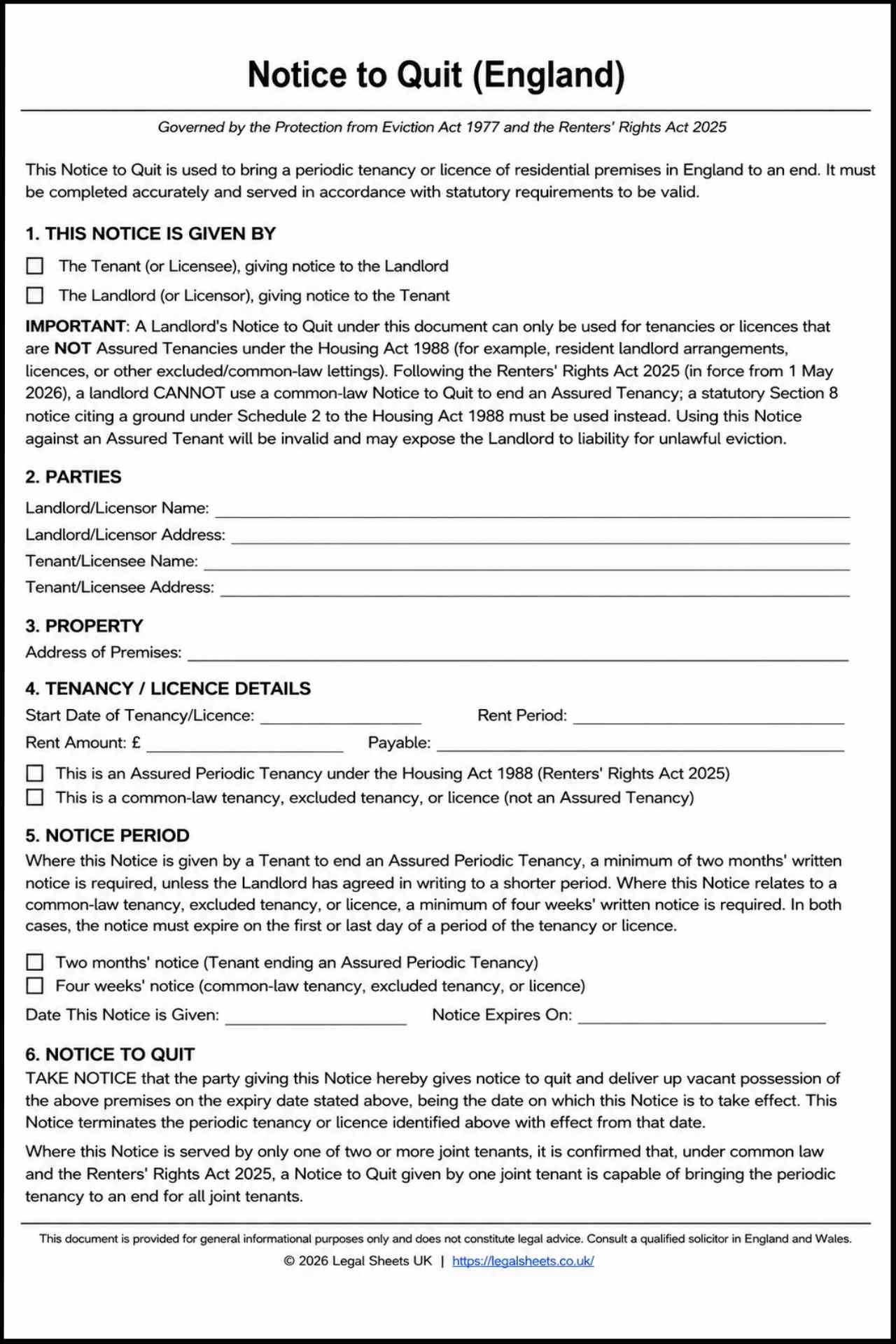
Before Filling In the Notice: Identify Which Legal Route You Are Actually Using
The most expensive mistake is often made before anyone writes the first line of the notice: choosing the wrong legal route. The template cannot correct a fundamental misclassification of the tenancy or occupation.
Is this a tenant’s Notice to Quit or a landlord’s Notice to Quit?
The first question is who is serving the document.
A tenant may use a Notice to Quit to end an assured periodic tenancy or a relevant common-law tenancy. A landlord’s position is much narrower. For an assured tenancy, the landlord cannot use an ordinary common-law Notice to Quit to obtain possession and must instead use the statutory Section 8 procedure.
For permitted common-law or non-assured residential arrangements, a landlord’s Notice to Quit may still have a role. That is why a form labelled simply “Notice to Quit” is potentially misleading unless its intended use is identified clearly.
Check the tenancy or occupation status first
Before completing the form, check whether the arrangement is:
- An assured periodic tenancy
- A common-law or non-assured tenancy
- A resident-landlord or excluded occupation
- Another type of occupation where ordinary Notice to Quit rules may differ
This is particularly important where the paperwork uses one description but the actual occupation has developed differently. The notice procedure follows the legal character of the occupation, so copying the wording from an earlier tenancy document without checking the present arrangement can create a procedural problem later.
The post-Renters’ Rights Act distinction
The Renters’ Rights Act changed the position for assured tenancies. A landlord cannot use a common-law Notice to Quit to end an assured tenancy and must use Section 8 instead.
That makes old templates especially risky. A document downloaded before the reforms may still contain wording associated with a procedure that is no longer appropriate for a landlord seeking possession of an assured tenancy. GOV.UK confirms that, from 1 May 2026, landlords seeking possession of an assured periodic tenancy must use the Section 8 process rather than Section 21.
Getting the Notice Period and Expiry Date Right
Notice periods are not simply numbers to insert into a blank field. The expiry date has to work with the type of tenancy and the applicable tenancy period.
Tenant notice for an assured periodic tenancy
Under the supplied legal framework, a tenant terminating an assured periodic tenancy must give at least two months’ written notice.
The notice should identify the property and clearly communicate the tenant’s intention to quit. The intended termination date should then be checked against the applicable tenancy period rather than selected merely because it is two months after the date written at the top of the notice.
A useful practical check is to work backwards from the intended leaving date. Confirm the required notice period, identify when the notice is being served and then check whether the proposed expiry date is actually capable of terminating the tenancy.
Common-law notice periods
For relevant common-law or non-assured arrangements, the supplied legal facts specify a minimum of four weeks’ written notice, with the notice expiring on the first or last day of a tenancy period.
This is where a generic four-week calculation can go wrong. Four weeks’ notice does not necessarily mean that any calendar date four weeks later can be inserted as the termination date. The tenancy period still matters.
The date-check that prevents a defective notice
Before serving the notice, check:
- The date the notice is served
- The date from which the notice period operates
- The minimum period required
- The contractual tenancy period
- The proposed expiry date
A notice that expires halfway through the relevant tenancy period can fail to terminate the tenancy as intended. The practical consequence is more than an inconvenient date change: the tenancy may continue, with rent liability continuing, until a legally effective notice is served.
What the Notice Needs to Say
A short notice can still require careful drafting. The aim is not to fill the document with legal language but to make the identity of the parties, property and intention to quit unmistakable.
Core identification details
The notice should accurately identify:
- The parties
- The full property address
- The tenancy or occupation concerned
- The intention to terminate or quit
- The intended termination date
Errors in names or addresses are particularly unhelpful if the document later becomes evidence in County Court proceedings. The final copy should therefore be checked against the tenancy agreement before service.
Tenant’s Notice to Quit wording
A tenant’s notice must be in writing. It should clearly and unequivocally communicate the intention to quit and contain the correct notice period and termination date.
Avoid wording that sounds like a request rather than a notice if the intention is to terminate the tenancy. The document should leave no uncertainty about what the tenant is communicating.
The distinction matters because an informal conversation with the landlord is not a substitute for a written Notice to Quit under the supplied legal framework.
Landlord’s prescribed wording for permitted common-law notices
A landlord serving a Notice to Quit in a permitted common-law residential situation has an additional drafting obligation. The prescribed information required by The Notices to Quit etc. (Prescribed Information) Regulations 1988 must be included.
The prescribed information addresses the need for a court order before lawful eviction and tells the occupier where legal advice may be obtained. This is not wording that should be casually paraphrased. Omitting or altering mandatory statutory wording can make the notice defective and undermine subsequent possession proceedings.
Serving the Notice: Where Good Drafting Can Still Fail
A correctly drafted notice can still become difficult to enforce if the serving party cannot establish that it was properly served.
Check the tenancy agreement’s service provisions
Start with the tenancy agreement. The supplied legal framework identifies Section 196 of the Law of Property Act 1925 as relevant where its provisions have been incorporated into the agreement.
That means the service clause should be checked before deciding how to deliver the notice. A party should not assume that the method used for an earlier letter is automatically appropriate for a formal Notice to Quit.
Practical service methods
Depending on the applicable service provisions, practical methods may include:
- Personal hand delivery
- First-class post
- Recorded or registered delivery where appropriate
- Leaving the notice at the property where the relevant service provision permits this
The precise method should be consistent with the tenancy agreement and applicable service rules.
Keep evidence that proves service
Keep:
- A copy of the exact notice served
- Certificate of postage
- Delivery confirmation where available
- A signed receipt where obtained
- Witness evidence of hand delivery
- The date and method of service
This evidence becomes particularly valuable when the recipient later says that the notice never arrived. A County Court dispute can turn on whether the claimant can establish the service relied upon, not simply whether a notice was drafted.
When a Notice to Quit Does Not Give a Landlord the Right to Remove the Occupier
One of the most serious misunderstandings is treating expiry of a notice as permission to physically evict someone.
Expiry of the notice is not the same as physical eviction
Where a court order is required, the expiry of a Notice to Quit does not authorise the landlord to change the locks, remove belongings or physically force the occupier out.
The Protection from Eviction Act 1977 is relevant to this distinction. A landlord who bypasses the required possession procedure can face illegal-eviction consequences.
Where possession proceedings become necessary
If the occupier remains after the notice has expired in a situation requiring court intervention, the dispute moves into the County Court possession process.
The notice and evidence of service can then become part of the possession case. A defective notice can therefore cause a problem at a much later stage than the date on which it was originally served.
Where a possession order is obtained, enforcement can then proceed through the appropriate enforcement route, including County Court Bailiffs or High Court Enforcement Officers where applicable.
The excluded-occupier distinction
Resident-landlord arrangements require particular care. An excluded occupier who shares living accommodation with a resident landlord may be subject to different possession requirements.
That does not mean that every landlord living at a property can simply bypass the normal procedure. The actual occupation needs to be established first, because choosing the wrong route can expose the landlord to unnecessary dispute or enforcement problems.
Joint Tenancies and the Consequences of One Tenant Giving Notice
Joint tenancies create a particularly important consequence because the person completing the form may not be the only person affected by it.
One joint tenant serving notice
Under the supplied legal facts, a valid Notice to Quit from one joint tenant can terminate the periodic tenancy for all joint tenants.
This means a tenant should not assume that giving notice only affects their own occupation. Other tenants may lose the existing joint tenancy even though they did not personally sign or serve the notice.
Practical checks before accepting or serving the notice
Before relying on the notice, check:
- Names appearing on the tenancy
- Whether the tenancy is joint
- Whether the tenancy remains periodic
- Whether the notice is intended to terminate the whole tenancy
- Whether the parties understand the consequences
Where some occupants want to remain, the position may require a fresh tenancy arrangement rather than an assumption that the old joint tenancy simply continues.
Common Ways a Notice to Quit Becomes Defective
Using a landlord Notice to Quit for an assured tenancy
This is one of the most significant errors after the Renters’ Rights Act reforms.
A landlord cannot use a common-law Notice to Quit to end an assured tenancy. The appropriate route is Section 8, with the relevant possession ground and statutory notice procedure.
Trying to use the wrong notice can leave the landlord without a usable possession route and can create serious problems if the landlord then attempts to remove the occupier without following the required process. GOV.UK confirms that landlords seeking possession of assured periodic tenancies must use Section 8 after 1 May 2026.
Giving too little notice
A tenant on an assured periodic tenancy must provide the required two months’ written notice under the supplied legal framework. Relevant common-law arrangements carry the stated four-week minimum.
Serving a shorter notice does not simply make the tenant’s move-out date more convenient. The notice may fail to terminate the tenancy when intended, leaving rent and occupation continuing beyond the date the tenant expected.
Choosing the wrong expiry date
Even when the correct number of days or weeks has been considered, the expiry date can still be wrong.
A notice that ends part-way through the tenancy period may fail to terminate the tenancy correctly. The result can be another notice, another notice period and another period during which the parties remain tied to the tenancy.
Leaving out prescribed landlord information
For a permitted landlord Notice to Quit concerning a common-law residential occupation, the prescribed statutory information is not optional drafting material.
Leaving it out can make the notice defective. If possession proceedings later depend on that notice, the defect can become a direct obstacle to obtaining possession.
Assuming an old template is still suitable
Old templates are particularly dangerous in this area because the Renters’ Rights Act changed the possession system for assured tenancies.
An online form labelled “Notice to Quit” or “Section 21 Notice” may reflect an earlier procedure. The user should therefore establish the tenancy type and legal route before relying on the wording.
Can a Notice to Quit Be Withdrawn?
A notice can have consequences that are difficult to reverse, so changing one’s mind should not be treated as a simple editing exercise.
Tenant changes their mind after serving notice
Under the supplied legal facts, a tenant who has served and delivered a valid Notice to Quit cannot unilaterally withdraw it.
If the tenant wants to remain, the landlord’s agreement is required. Simply sending another letter saying “please ignore my previous notice” should not be assumed to cancel the original notice.
What happens if the parties want the tenancy to continue?
If the landlord agrees that the tenant can remain, the parties should record that agreement properly.
Where the original tenancy has been brought to an end, a new tenancy agreement may be required. The important practical point is to avoid leaving the parties relying on an informal assumption that the old tenancy has somehow been restored.
UK Legal Facts: Notice to Quit Requirements
Legal Requirements Table
| Topic / Issue | England Legal Rule | Governing Law |
|---|---|---|
| Tenant notice for an assured periodic tenancy | Minimum two months’ written notice | Renters’ Rights Act / Protection from Eviction Act 1977, s.5 |
| Common-law notice | Minimum four weeks’ written notice for relevant non-assured arrangements, expiring on the first or last day of a tenancy period | Protection from Eviction Act 1977, s.5 |
| Written notice | A valid Notice to Quit must be served in writing | Protection from Eviction Act 1977, s.5 |
| Joint tenancy | A valid notice from one joint tenant can terminate the periodic tenancy for all joint tenants | Common law / Renters’ Rights Act |
| Landlord common-law notice | Prescribed statutory information concerning court orders and legal advice must be included | The Notices to Quit etc. (Prescribed Information) Regulations 1988 |
| Service | Service may depend on contractual provisions, including incorporation of Section 196 requirements | Law of Property Act 1925, s.196 |
| Landlord ending assured tenancy | A common-law Notice to Quit cannot be used to end an assured tenancy; Section 8 is required | Housing Act 1988 / Renters’ Rights Act |
Practical Legal Impact
The table shows why the first step is classification, not completion. A person who selects the wrong document can satisfy every blank on the form and still have the wrong notice.
The Protection from Eviction Act 1977, Section 5 is particularly relevant to the written nature and notice requirements identified above. The 1988 prescribed-information regulations create an additional requirement for a landlord using a Notice to Quit in a permitted common-law residential setting.
Service is a separate issue. Section 196 of the Law of Property Act 1925 becomes relevant where its provisions have been incorporated into the tenancy agreement. If the recipient disputes receipt, evidence of how and when the notice was served may become significant in the County Court.
The modern assured-tenancy position is also distinct. GOV.UK confirms that from 1 May 2026 a landlord seeking possession of an assured periodic tenancy must use Section 8 and the prescribed Form 3A route.
Notice to Quit vs Other Possession and Tenancy Documents
Using the right document becomes easier once the documents are separated by function.
Notice to Quit vs Section 8 notice
A Notice to Quit has a role in the situations identified above, including a tenant’s termination of an assured periodic tenancy and permitted common-law arrangements.
Section 8 is different. It is the statutory possession route for a landlord seeking to end an assured tenancy. The landlord must rely on a possession ground and use the applicable statutory notice procedure.
Confusing the two can result in a landlord preparing a document that cannot achieve the intended possession outcome.
Notice to Quit vs Section 21 notice
Section 21 belongs to the former possession system for assured shorthold tenancies.
After the Renters’ Rights Act reforms took effect on 1 May 2026, landlords cannot use Section 21 to seek possession of an assured periodic tenancy. GOV.UK confirms that landlords now use Section 8 for possession of these tenancies.
This is why an old Section 21 template should not simply be substituted for a Notice to Quit or vice versa.
Notice to Quit vs possession order
A notice is not the same thing as a possession order.
Where a court order is required, the notice is part of the process leading towards a County Court possession claim. The notice itself does not give the landlord permission to use force against the occupier.
Notice to Quit vs surrender agreement
A Notice to Quit operates as a notice terminating the tenancy or occupation according to the applicable rules.
A surrender is different because it involves an agreement to end the tenancy. Where the parties genuinely agree on an earlier termination, documenting that agreement can be materially different from relying on a unilateral notice.
Evidence to Keep With the Completed Notice
Notice records
Keep the final version that was actually served, together with:
- Date of preparation
- Date of service
- Property address
- Names of the parties
- The completed notice itself
Do not rely on a blank template retained after service. If the notice is later challenged, the relevant evidence is the version actually delivered.
Service evidence
Retain:
- Certificate of postage
- Delivery confirmation
- Signed acknowledgement where available
- Witness details for personal delivery
A recipient’s denial of receipt becomes much easier to address when the serving party has retained contemporaneous evidence.
Supporting tenancy records
Keep the:
- Tenancy agreement
- Relevant service clause
- Records identifying the tenancy period
- Relevant communications concerning the notice
These records allow the notice to be considered in context rather than as an isolated document.
A Practical Notice-to-Quit Completion Workflow
Before writing the notice
- Identify who is serving it
- Establish the tenancy or occupation type
- Confirm that a Notice to Quit is legally available for that situation
- Review the tenancy agreement
- Identify the applicable notice period
- Check the relevant termination date
The purpose of this stage is to prevent the common mistake of completing a form before establishing whether the form is actually appropriate.
While completing the notice
- Enter accurate party names
- Enter the complete property address
- Identify the tenancy or occupation
- Calculate the expiry date carefully
- State the intention to quit clearly
- Insert prescribed information where the landlord’s common-law notice requires it
- Check the completed document against the tenancy agreement
The final review should be done before printing or serving the notice. Correcting a mistake after service may not be as simple as editing the Word version.
At service
- Select a permitted service method
- Follow the tenancy agreement where applicable
- Record the date and method
- Obtain evidence of service
- Keep the exact copy served
The service record should be prepared at the same time as the notice is served rather than recreated months later when a dispute has already developed.
After expiry
Do not assume that expiry automatically authorises physical eviction.
Where court intervention is required, possession proceedings may need to follow. The notice, service evidence and underlying tenancy records should therefore be preserved in case they become part of the County Court evidence.
Edge Cases That Need More Than a Generic Notice Template
The tenant is on a joint tenancy
One tenant’s notice may affect the whole joint periodic tenancy. The other occupants should therefore not assume that the notice concerns only the person who signed it.
The landlord lives in the property
Resident-landlord arrangements can involve excluded occupier considerations. The landlord should establish the actual living and occupation arrangement before deciding which notice or possession procedure applies.
The tenancy is described incorrectly in the paperwork
A document may describe the arrangement in one way while the practical occupation points towards another legal category. Using the description on the first page of an old agreement without checking the current arrangement can lead to the wrong notice.
The recipient says they never received the notice
This becomes an evidential problem. The serving party should be able to identify when, how and where the notice was served and retain supporting evidence.
The tenant wants to withdraw the notice
A tenant cannot simply assume that a second communication cancels the first valid notice. If the parties want the occupation to continue, the landlord’s agreement should be obtained and the resulting arrangement properly documented.
FAQs
Can a landlord use a Notice to Quit to end an assured periodic tenancy?
No. Under the supplied England legal framework, a landlord cannot use a common-law Notice to Quit to end an assured tenancy. The landlord must use the Section 8 possession procedure. GOV.UK confirms the post-1 May 2026 position and the use of Form 3A for Section 8 notices.
How much notice must a tenant give on an assured periodic tenancy?
The supplied legal facts state that a tenant terminating an assured periodic tenancy must give at least two months’ written notice. The notice should identify the property, clearly communicate the intention to quit and use the correct termination date.
Can one joint tenant serve a Notice to Quit without the other?
Under the supplied legal facts, a valid notice from one joint tenant can terminate the periodic tenancy for all joint tenants. This means the person serving the notice should understand that the legal effect may extend beyond their own occupation.
What happens if a Notice to Quit has the wrong expiry date?
The notice may fail to terminate the tenancy on the intended date. If the expiry date does not comply with the applicable tenancy period or the required notice period is not given, the tenancy may continue and a valid replacement notice may be necessary.
Can a landlord change the locks after a Notice to Quit expires?
Not simply because the notice has expired. Where a court order is required, the landlord must follow the possession procedure rather than physically removing the occupier. GOV.UK likewise states that landlords cannot remove tenants by force and may face illegal-eviction consequences for failing to follow the correct procedure.