
Room Rental Agreement Template (Free Printable PDF Formats)
A Room Rental Agreement is often prepared just before someone moves into a spare room, yet many disputes arise because the document doesn’t accurately reflect the occupier’s legal status. In England, a homeowner may believe they have a simple lodger arrangement, only for a County Court to examine whether the occupier was actually granted exclusive possession and acquired greater tenancy rights than intended.
The problem is rarely the rent amount or payment date; it is usually the wording that fails to match how the property is occupied in practice. Where deposits are taken, requirements under the Housing Act 2004 can also become relevant depending on the nature of the arrangement. The template and supporting wording here are designed to help record room occupancy terms clearly from the outset and reflect the realities of shared living arrangements in England.
Affiliate Disclosure: We may earn a commission from purchases made through affiliate links on this page, at no extra cost to you.
Table of Contents
ToggleRoom Rental Agreement Template (PDF, Word & Printable Formats)
The template is typically used where a resident landlord rents a room to a lodger while continuing to occupy the property.
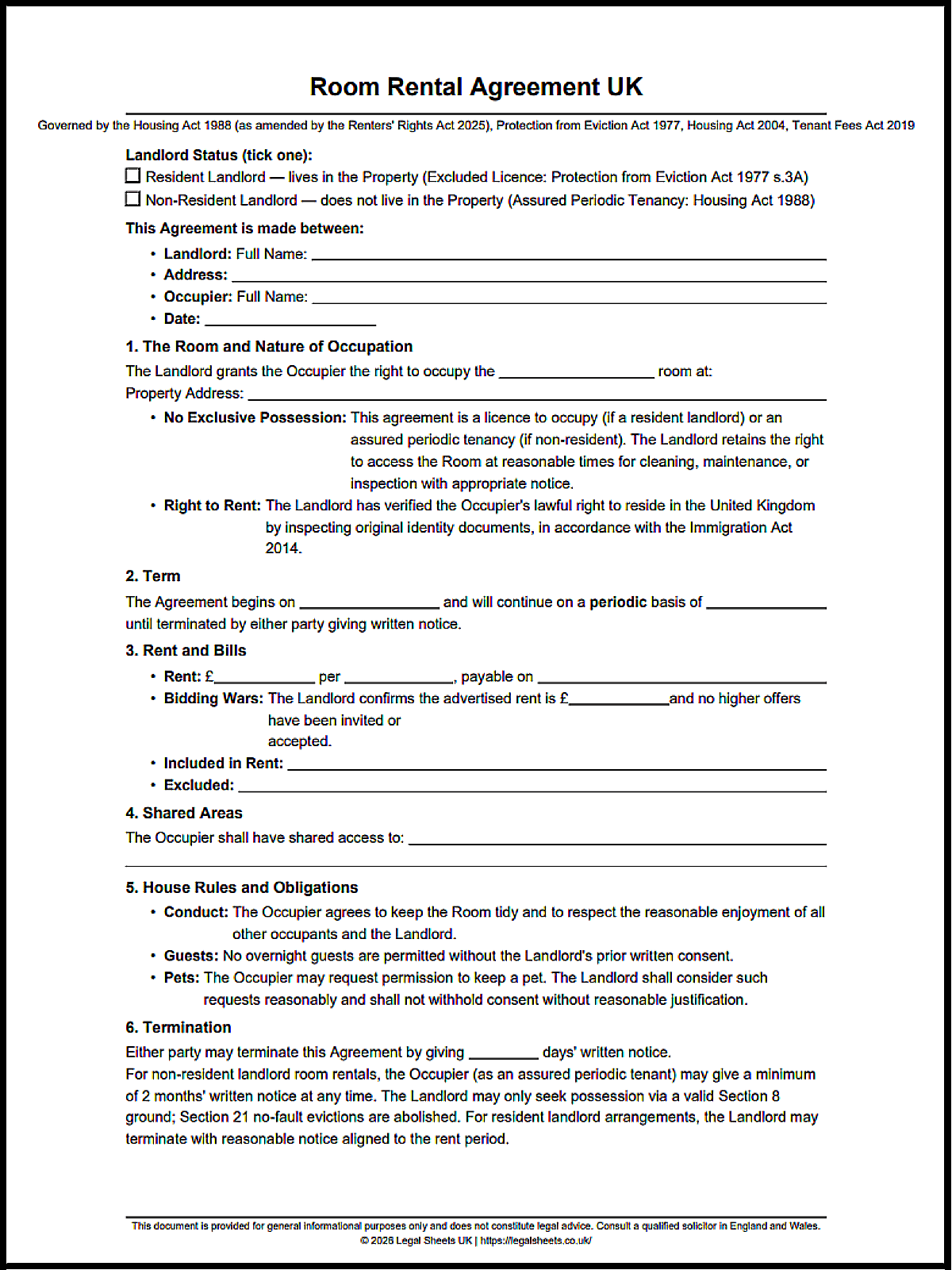
Customised Do-it-yourself Room Rental Agreement
Before Using a Room Rental Agreement, Confirm Whether You Need a Licence or a Tenancy
The most significant drafting decision is determining whether the arrangement is genuinely a licence.
Why This Decision Changes the Entire Legal Framework
Where a landlord shares accommodation such as kitchens, bathrooms, or living areas with the occupier, the arrangement will often fall within the category of an excluded occupancy governed largely by common law and contractual principles.
If the landlord does not reside in the property, the arrangement may instead fall within the tenancy regime governed by the Housing Act 1988, bringing substantially different obligations and regulatory requirements.
Landlords frequently focus on rent levels and notice periods while overlooking this classification issue. Yet it is usually the first question considered when a possession dispute reaches the County Court.
Shared-Home Arrangements
Shared occupation generally supports the existence of a licence arrangement. The continued presence of the landlord within the property is often one of the strongest indicators that the occupier is a lodger rather than a tenant.
Excluded Occupier Status
Lodgers are commonly treated as excluded occupiers. This affects notice rights and possession procedures and distinguishes them from occupiers with tenancy protection.
Licence to Occupy Characteristics
Typical characteristics include:
- Shared facilities
- Retained landlord control
- Ongoing landlord access
- House rules governing occupation
- Permission to occupy rather than exclusive possession
Situations That May Create a Tenancy Unintentionally
Problems arise when the document says one thing but daily practice shows another.
Examples include:
- The occupier controls access entirely
- The landlord never enters the room
- Occupation functions independently from the landlord, similar to renting a whole property.
- Shared accommodation arrangements cease in reality
Indicators That the Arrangement Is Likely a Lodger Agreement
Certain practical features support classification as a licence.
Landlord Lives in the Property
The landlord’s continued residence is often central to the arrangement.
Kitchen and Bathroom Facilities Are Shared
Shared use of household facilities commonly reflects a lodger relationship rather than an independent tenancy.
Landlord Retains Control of the Accommodation
Control over the accommodation should remain consistent with a licence arrangement.
Occupier Receives Permission to Occupy Rather Than Exclusive Possession
The occupier is granted permission to use accommodation subject to agreed conditions rather than unrestricted control.
Warning Signs That Courts May Treat the Arrangement as a Tenancy
Many reclassification disputes begin because the parties gradually stop operating according to the written agreement.
Occupier Has Unrestricted Control Over the Room
Complete control may indicate exclusive possession.
Landlord Cannot Access the Room Except by Permission
Where the landlord effectively loses access rights, the arrangement may begin to resemble a tenancy.
Occupation Operates Independently from the Landlord
A court will examine practical reality rather than contractual labels.
Practical Reality Conflicts With the Wording of the Agreement
A document describing a licence carries limited weight if everyday occupation points in the opposite direction.
The Clauses That Most Often Determine Whether the Agreement Remains a Licence
The wording of certain provisions frequently becomes important during disputes.
Landlord Access Rights
Access provisions should reflect the landlord’s retained control. Poorly drafted clauses often become a focal point when classification is challenged.
Shared Accommodation Provisions
The agreement should accurately identify shared facilities and how they are used.
House Rules and Occupation Standards
House rules demonstrate that occupation remains subject to ongoing conditions rather than unrestricted possession.
Room Use Restrictions
Restrictions on use support the intended structure of the arrangement.
Visitor and Overnight Guest Controls
Guest provisions frequently prevent disputes over unauthorised occupation in shared household arrangements.
Cleaning and Maintenance Responsibilities
Clear responsibilities reduce conflict over communal living standards.
Keys, Security, and Property Access
Key arrangements should remain consistent with the intended licence structure.
Payment Arrangements That Cause Disputes in Shared Homes
Money-related disagreements account for many room rental disputes.
Rent Collection Terms
The agreement should specify payment dates, methods, and expectations regarding late payments.
Deposit Handling Expectations
Under common law, there is generally no statutory requirement to protect a lodger deposit within a government-authorised deposit scheme. That does not remove the need for clear written terms regarding deductions and repayment.
Utility and Broadband Contributions
Shared-home disputes frequently arise when utility contributions are not clearly allocated.
Late Payment Procedures
Ambiguous procedures often result in disagreement over arrears and deductions.
Damage Recovery Provisions
The agreement should explain how damage claims will be assessed and evidenced.
Inventory and Condition Records
Photographs and written inventories often become valuable evidence if deductions are later disputed.
Occupancy Rules That Reduce Conflict Between Landlord and Lodger
Many successful arrangements depend less on legal drafting and more on realistic household expectations.
Shared Kitchen and Bathroom Expectations
Practical rules regarding cleaning and storage often prevent recurring disputes.
Quiet Hours and Nuisance Prevention
Noise complaints frequently become the catalyst for notice being served.
Storage and Personal Belongings
Clear expectations reduce arguments about communal space.
Smoking, Vaping, and Pets
Restrictions should be clearly stated from the outset.
Guest Policies
Many resident landlords underestimate how quickly disputes develop over frequent overnight visitors.
Use of Common Areas
The agreement should define how communal areas may be used.
Ending the Arrangement Without Creating Possession Problems
Possession disputes often originate from poorly documented notice procedures.
Setting a Clear Notice Period
The agreement should specify the notice arrangements expected by both parties.
What Counts as Reasonable Notice
Under the Protection from Eviction Act 1977, reasonable notice is generally required. In practice, this is often one rental period or approximately 28 days, although circumstances may vary.
Written Notice Best Practices
Providing notice in writing creates a record that may later be relied upon in court.
Evidence of Service
Landlords frequently encounter difficulties proving service. Recorded delivery, signed acknowledgements, or documented hand delivery can become important evidence.
What Happens if the Lodger Leaves Early
The agreement should address outstanding rent, deposits, and return of keys.
Recovering Outstanding Rent or Damage Costs
Documentary evidence is often decisive when pursuing unpaid sums.
When a Lodger Refuses to Leave After Notice
The most costly mistakes typically occur at this stage.
Why Self-Help Eviction Creates Legal Risk
Frustrated landlords sometimes believe that lodger status allows immediate removal. That assumption can create serious legal problems.
Lock Changes and Removal of Belongings
Because genuine lodgers are classed as ‘excluded occupiers’ under the Protection from Eviction Act 1977, resident landlords do not require a court order. Once the reasonable notice period expires, you are legally entitled to execute a ‘peaceable eviction’ by simply changing the locks while the lodger is out. Using physical violence or threatening behaviour, however, remains a strict criminal offence.
County Court Possession Proceedings
A County Court possession order is fundamentally unnecessary for a true lodger. However, if the arrangement inadvertently granted the occupier exclusive control—upgrading them to a fully protected Assured Periodic Tenancy under the Renters’ Rights Act 2025—a lock change becomes a criminal illegal eviction. Court proceedings are only required if their legal lodger status is genuinely in dispute.
Evidence That Strengthens a Possession Claim
Useful evidence may include:
- Signed agreement
- Notice documents
- Proof of service
- Payment records
- Correspondence
- Evidence that the landlord remained resident
Practical Steps Before Court Action
Many possession claims become more straightforward where records have been maintained consistently from the start of the arrangement.
Compliance Checks Often Overlooked in Room Rental Arrangements
Small compliance failures frequently become larger problems during disputes.
Gas Safety Documentation
Landlords must provide a current Gas Safety Certificate before occupation begins. Annual gas safety inspections remain mandatory under the Gas Safety (Installation and Use) Regulations 1998.
For the legislation, see the Gas Safety (Installation and Use) Regulations 1998.
Smoke and Carbon Monoxide Alarm Requirements
Smoke alarms and carbon monoxide alarms must be installed where required under the Smoke and Carbon Monoxide Alarm (England) Regulations 2015.
Information is available through GOV.UK.
Electrical Safety Responsibilities
Electrical systems must be kept safe. Poor maintenance can become highly relevant if injury or property damage occurs.
Landlord Contact Information Requests
Pursuant to Section 1 of the Landlord and Tenant Act 1985, the occupier may request the landlord’s name and address, which must be supplied in writing within 21 days.
The legislation can be reviewed on Landlord and Tenant Act 1985.
Record-Keeping Practices That Support Enforcement
Written records often become more persuasive than witness recollections months later.
Common Drafting Errors That Reclassify a Room Let Agreement
Granting Exclusive Possession by Accident
This remains one of the most common mistakes. A clause granting unrestricted control can undermine the intended licence arrangement.
Using Tenancy Language in a Licence Agreement
Copying wording from tenancy agreements can create unnecessary ambiguity.
Contradictory Access Clauses
Conflicting provisions regarding room access often attract scrutiny during disputes.
Unclear Notice Provisions
Unclear notice wording frequently creates evidential arguments that could have been avoided.
Unfair Penalty Clauses
Under the Consumer Rights Act 2015, terms creating a significant imbalance to the occupier’s detriment may be unenforceable.
House Rules That Cannot Realistically Be Enforced
Rules disconnected from how the property actually operates often carry little practical value.
UK Legal Facts Affecting a Room Rental Contract
| Topic / Issue | England Legal Rule | Governing Law |
|---|---|---|
| Deposit Protection | Exempt; lodger deposits do not legally require placement in a government-backed scheme. | Housing Act 2004 |
| Notice to Quit | Reasonable notice” is required (typically matching the rent payment frequency, e.g., one month). | Protection from Eviction Act 1977 |
| Gas Safety | Mandatory annual boiler/appliance inspections and certification by a Gas Safe engineer. | Gas Safety (Installation and Use) Regulations 1998 |
| Electrical Safety | Landlords hold a duty of care to ensure fixed electrical systems and supplied appliances are safe. | Landlord and Tenant Act 1985 / Common Law |
| Right to Rent | Mandatory; resident landlords MUST verify the immigration status of any lodger moving in. | Immigration Act 2014 |
| Eviction Mechanism | Court order NOT required for true lodgers; peaceable lock changes are entirely lawful post-notice. | Protection from Eviction Act 1977 (s.3A) |
| Smoke & CO Alarms | Required in qualifying circumstances | Smoke and Carbon Monoxide Alarm (England) Regulations 2015 |
| Landlord Details | Written details must be supplied if requested | Landlord and Tenant Act 1985 |
Practical Legal Impact
The wording of a room tenancy agreement directly affects whether the arrangement remains outside the tenancy regime. Weak drafting often creates uncertainty that surfaces only after relations have broken down.
County Court judges routinely examine occupation patterns, access arrangements, notices, and documentary evidence. A licence that is poorly drafted and inconsistently operated may provide far less protection than landlords expect.
Documents Often Confused With a Room Rental Agreement
- Lodger Agreement
- Assured Periodic Tenancy Agreement
- Occupancy Agreement
- House Share Agreement
- Tenancy Agreement for an Entire Property
- Licence to Occupy
Although these documents may appear similar, they address different occupation structures and legal risks.
Situations Where Professional Advice May Be Worth Obtaining
Professional assistance may be valuable where:
- Occupation arrangements are complex
- A possession dispute already exists
- Tenancy reclassification is a concern
- County Court proceedings are anticipated
- Multiple occupiers reside within the property as a shared household arrangement.
Frequently Asked Questions
Can a room rental agreement become a tenancy even if the document says “Licence to Occupy”?
Yes. Courts focus on the reality of occupation, particularly whether exclusive possession has been granted.
What is the biggest legal risk when creating a room let agreement?
Accidentally creating tenancy rights through drafting or operational practices that provide exclusive control over accommodation.
Can a landlord change the locks to evict a lodger?
Once the specified ‘reasonable notice’ period has fully expired, yes. Excluded occupiers do not benefit from standard court eviction protections. You may lawfully perform a peaceable lock change while they are away from the property, provided you allow them to collect their belongings later.
Is a lodger deposit required to be protected in a government deposit scheme?
No. Lodger agreements are generally exempt from statutory tenancy deposit protection requirements under the verified legal framework applicable to excluded occupiers.
What evidence is most useful if a possession dispute reaches court?
The signed agreement, written notices, proof of service, payment records, correspondence, and evidence showing that the landlord remained resident and retained control of the property are often among the most persuasive forms of evidence.
Author
-

Ankur is the founder and editorial reviewer at LegalSheets. He researches, writes, and reviews legal content, ensuring every template and guide is clear, accurate, and based on current UK laws and official government guidance. His focus is on making legal documents easier for individuals and businesses to understand and use.
