
Statutory Declaration Template Fillable PDF
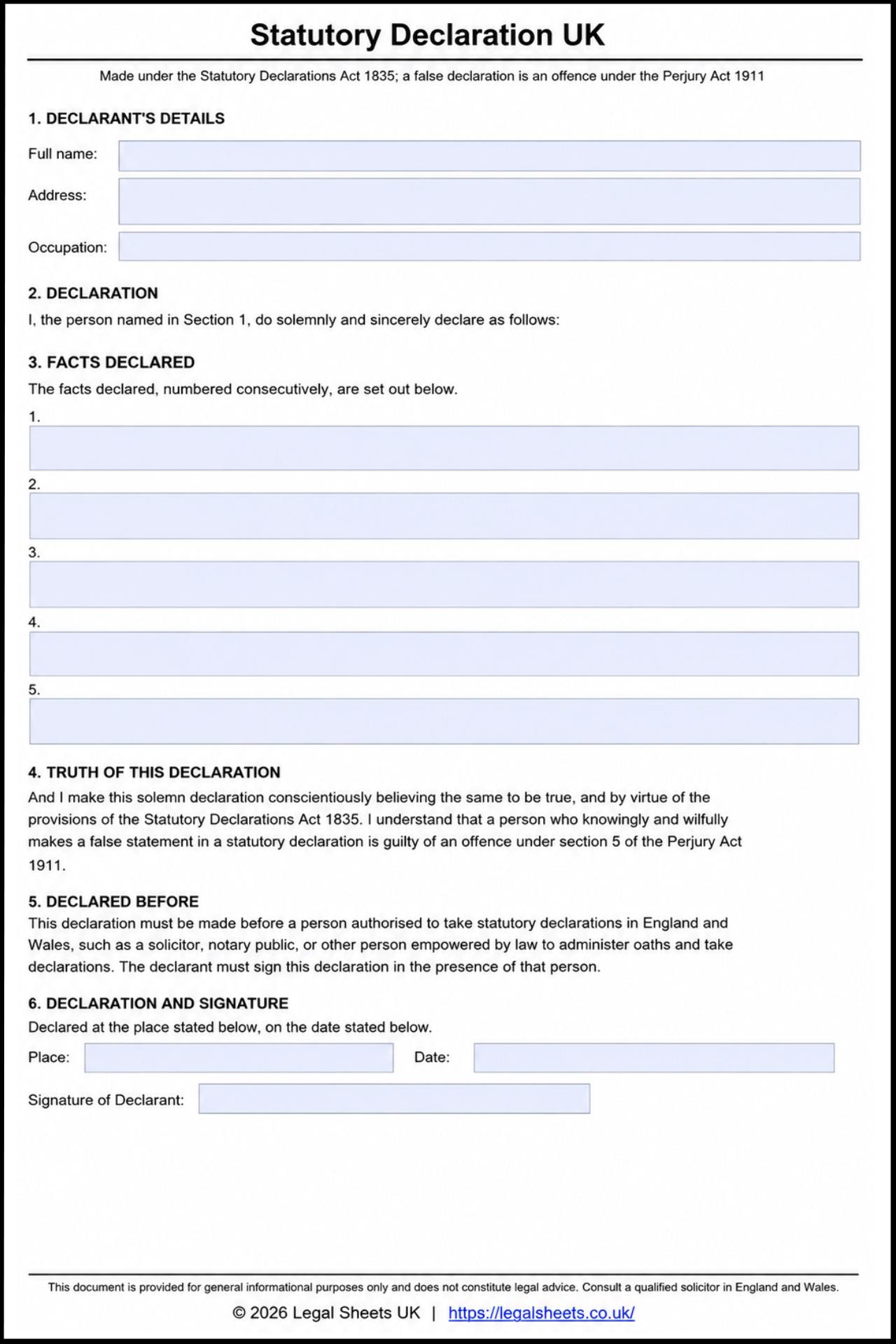
A Statutory Declaration is often needed when a person must formally confirm facts in writing for an organisation, authority, or legal process, but mistakes in wording, witnessing, or execution can cause delays when the document is later relied upon. A Statutory Declaration in England is governed by specific legal requirements, including the Statutory Declarations Act 1835, and must be made before an authorised person such as a solicitor or commissioner for oaths.
In practice, problems commonly arise when declarations contain unclear statements, incorrect wording, or are signed without the required witnessing procedure, making them unsuitable for the purpose they were prepared for. This template provides the correct structure and practical information needed when preparing a Statutory Declaration for use in England.
Statutory Declaration Template Guide
When Is a Statutory Declaration Used?
A statutory declaration may be required where an organisation, authority, or legal process requires a formal statement of facts rather than an ordinary signed letter.
Common uses include:
- confirming a change of name
- declaring ownership or entitlement
- confirming loss of documents
- supporting administrative applications
- verifying facts for legal or commercial purposes
- confirming execution of certain documents
The person making the declaration is known as the declarant. The declarant must understand that the statement is made formally and that making a false declaration can have serious legal consequences.
Legal Requirements for a Statutory Declaration in England
A statutory declaration must follow certain formal requirements to be effective.
Written Declaration
The declaration must be in writing and must clearly set out the facts being declared.
The wording should identify:
- the full name of the declarant
- the address or relevant identification details
- the facts being declared
- the legal declaration wording
- the signature of the declarant
The Statutory Declarations Act 1835 provides the legal basis for voluntary statutory declarations made before an authorised person.
Declaration Before an Authorised Person
The declarant must sign the document in the presence of someone authorised to administer oaths.
This may include:
- a solicitor
- commissioner for oaths
- notary public
- another person authorised by law
The authorised person confirms that the declaration was properly made.
Signature Requirements
The declarant must sign the statutory declaration in the presence of the authorised person.
The authorised person will usually complete the certification section confirming that the declaration was made before them.
A statutory declaration should contain the appropriate declaration wording and certification details to demonstrate compliance with the statutory requirements.
Statutory Declaration Template Structure
A properly prepared statutory declaration template usually contains the following sections.
Title and Heading
The document should clearly state that it is a statutory declaration.
Example:
STATUTORY DECLARATION
This helps distinguish it from ordinary statements, letters, or witness statements.
Declarant Details
The document should include:
- full legal name
- address
- occupation or relevant identifying details where required
The declarant should be clearly identified before making the declaration.
Declaration Statement
This section contains the facts being declared.
The wording should be:
- accurate
- specific
- limited to facts within the declarant’s knowledge
- free from unnecessary opinions or assumptions
A statutory declaration should not include misleading statements or information the declarant cannot properly confirm.
Legal Declaration Clause
Under Section 20 and the Schedule to the Statutory Declarations Act 1835, the document must conclude with the mandatory statutory formula: ‘And I make this solemn declaration conscientiously believing the same to be true, and by virtue of the provisions of the Statutory Declarations Act 1835.’ Omitting this statutory wording invalidates the declaration.
Signature and Certification Section
The document should include:
- declarant signature
- date
- place where declaration was made
- signature of authorised person
- name and qualification of authorised person
Who Can Witness a Statutory Declaration?
A statutory declaration must be made before a person authorised to administer oaths.
Common authorised persons include:
- solicitors
- commissioners for oaths
- notaries public
The administering commissioner performs a formal statutory function under the Commissioners for Oaths Act 1889. They confirm the declarant’s identity, ensure the declarant verbally repeats the solemn declaration in their physical presence, and endorse any attached exhibits in exchange for the fixed statutory fee set by the Commissioners for Oaths (Fees) Order 1993.
Does a Statutory Declaration Need a Witness?
Yes. A statutory declaration must be signed in the presence of an authorised person.
A declaration signed privately without the required certification may not be accepted where a statutory declaration is required.
Is a Statutory Declaration Legally Binding?
A statutory declaration is a formal legal document. The person making it confirms that the information stated is true.
Under Section 5 of the Perjury Act 1911, knowingly and wilfully making a material false statement in a statutory declaration is an indictable criminal offence, punishable on conviction by up to two years’ imprisonment, a fine, or both.
The seriousness of the document means declarants should only include information they genuinely believe to be accurate.
Cleaned Summary Table of Applicable Laws
| Topic / Issue | Precise Legal Rule | Governing Statute / Statutory Instrument |
| Mandatory Statutory Formula | Must conclude with the prescribed concluding wording referencing the 1835 Act to possess statutory validity. | Statutory Declarations Act 1835 (Section 20 & Schedule) |
| Administering Authority | Must be formally declared before an authorised, independent person (Solicitor, Notary, Commissioner for Oaths, or CILEX Fellow). | Commissioners for Oaths Act 1889 (Section 1) / Legal Services Act 2007 |
| Independence & Conflict of Interest | The administering solicitor must have no interest in the matter or represent the declarant in the underlying transaction. | Commissioners for Oaths Act 1889 (Section 1(3)) / SRA Standards |
| Criminal False Statement Penalty | Knowingly and wilfully declaring false material facts is an indictable offence carrying up to two years’ imprisonment. | Perjury Act 1911 (Section 5) |
| Prescribed Statutory Admin Fee | Standard fixed statutory fee payable to the administering commissioner (£5 for the declaration, £2 per exhibit). | Commissioners for Oaths (Fees) Order 1993 (SI 1993/2298) |
| Lease Contracting-Out Declarations | Contracting out of 1954 Act renewal rights without 14 days’ notice strictly requires the prescribed statutory declaration form. | Regulatory Reform (Business Tenancies) Order 2003 (Schedule 2) |
| Members’ Liquidation Solvency | Declarations of solvency in solvent liquidations must be filed with Companies House within 15 days of resolution. | Insolvency Act 1986 (Section 89) |
Common Uses of Statutory Declaration Templates
Change of Name
Statutory declarations may sometimes be used alongside name change processes or supporting evidence requirements.
Certain organisations may require formal evidence confirming identity or circumstances.
Lost Documents
A person may use a statutory declaration to confirm that an important legal document has been lost and explain the circumstances.
Property and Ownership Matters
Statutory declarations can be used to confirm facts relating to ownership, interests, or historical circumstances.
Business and Commercial Matters
Companies and individuals may use statutory declarations where formal confirmation of commercial matters is required.
Common Mistakes When Preparing a Statutory Declaration
Including False or Unverified Information
A statutory declaration should only contain facts the declarant can honestly confirm.
Incorrect statements may create legal problems.
Using Incorrect Wording
Although there is not one universal template for every situation, the document must contain the required declaration wording and certification details.
Signing Before Meeting the Witness
The declarant should not sign the document before appearing before the authorised person if the signature must be witnessed.
Confusing a Statutory Declaration With an Affidavit
Using the wrong document type may result in rejection by an organisation or authority.
Failing to Identify the Declarant Properly
Missing names, addresses, or identification details can cause acceptance issues.
Statutory Declaration Template Checklist
Before signing, check that the document includes:
- full declarant details
- clear statement of facts
- correct statutory declaration wording
- declarant signature
- date and place of declaration
- authorised witness certification
- accurate supporting information
Frequently Asked Questions
Is a statutory declaration legally binding?
Yes. A statutory declaration is a formal legal document where the declarant confirms that the stated facts are true. It must be made following the required legal procedure.
Does a statutory declaration need to be witnessed?
Yes. The declarant must make the declaration before a person authorised to administer oaths, such as a solicitor or commissioner for oaths.
Can I write my own statutory declaration?
Yes. There is no single universal statutory declaration form for every situation. However, the document must contain the required wording and be properly completed and certified.
Do I need a solicitor for a statutory declaration?
No specific statutory requirement requires a solicitor in every case. However, the declaration must be made before an authorised person who can administer oaths.
What happens if a statutory declaration contains false information?
Making a false statutory declaration can create legal consequences because the declarant has formally confirmed the truth of the statement.
Does a statutory declaration need to be filed anywhere?
No specific statutory requirement; governed by the purpose for which the declaration is being used.
A statutory declaration is generally provided to the organisation, authority, or person requesting it rather than being automatically registered or filed.
How long is a statutory declaration valid?
There is no general expiry period for all statutory declarations. Acceptance depends on the purpose, the organisation requesting it, and whether the facts remain accurate.